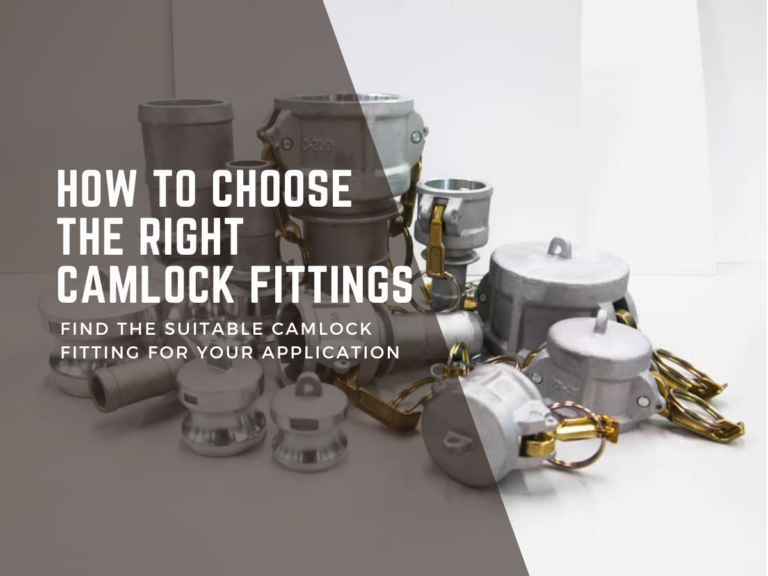
Camlock fittings (also called cam-and-groove couplings) provide rapid, tool-free connection of hoses and pipes for chemical, water, and beverage transfer service. At Simlecco, you’ll find a variety of camlocks to meet industrial connection requirements.
What Is a Camlock Fitting?
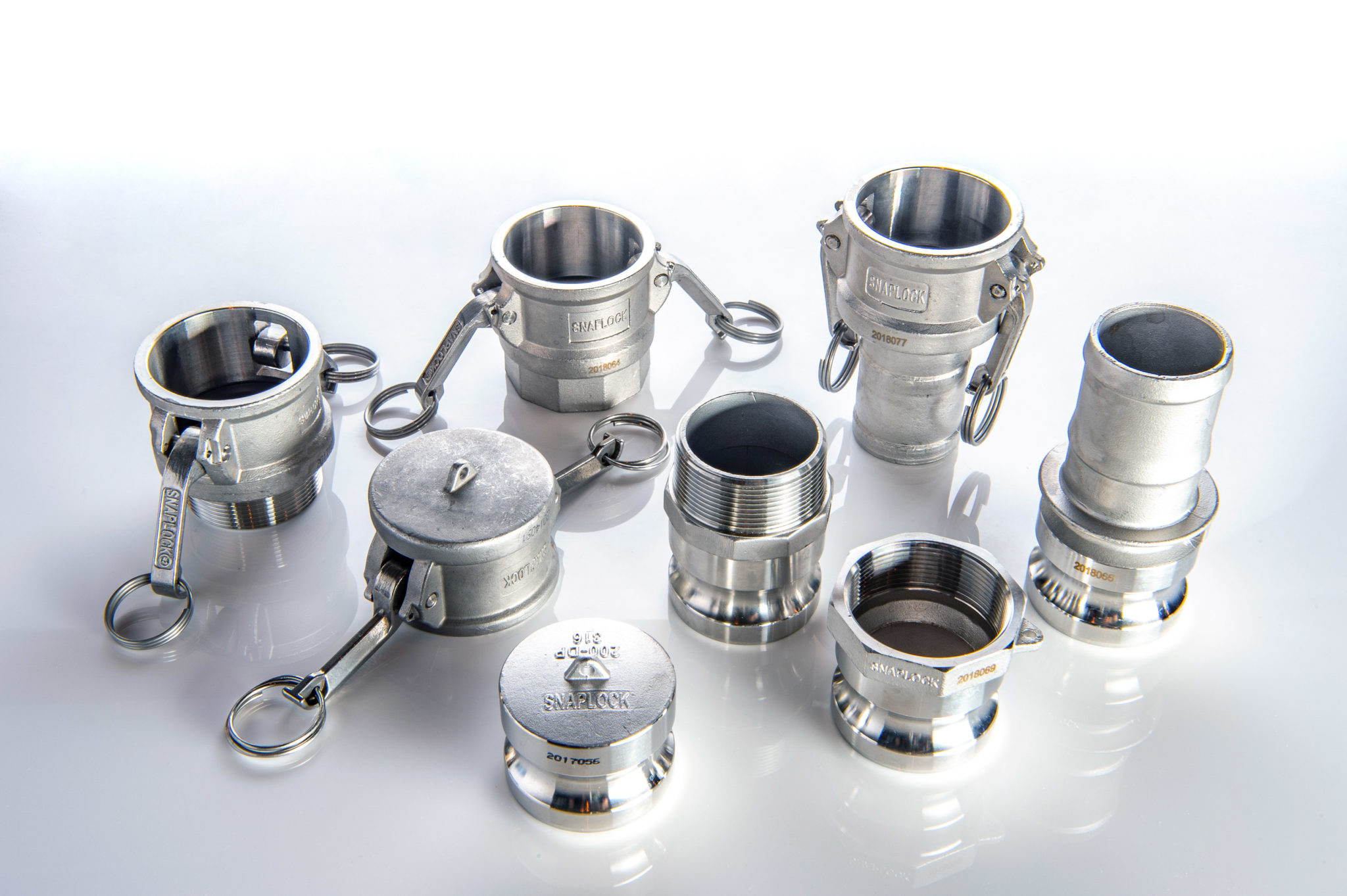
Camlock fittings — also called cam-and-groove fittings — connect hoses and tubes (see our primer on what a flexible hose is) to a pipe or pump. These couplings consist of male and female components that mate without thread sealants or tape. A gasket (typically NBR, EPDM, FKM, or PTFE) generates the seal.
To engage a camlock, the female coupler’s cam arms close over the male adapter’s groove and compress the gasket against the adapter face. This produces a pressurised, leak-tight seal. Connection and disconnection are by hand or with standard wrenches — no specialty tooling required. Simlecco male and female camlock geometries are dimensioned to A-A-59326 / EN 14420-7 and interchange with industry-standard fittings.
Camlock couplings are used across manufacturing and industrial service, including with industrial hoses for oil and gas. Match the body material (aluminium, stainless 316L, brass, polypropylene, carbon steel) and gasket to the service medium, then specify the type pairing against the mating fitting on the other side of the transfer.
What Kind of Camlocks Does Simlecco Offer?
Simlecco offers the eight standard camlock types. Each is dimensioned to A-A-59326 / EN 14420-7:
- Type A: male adapter with female NPT thread.
- Type B: female coupler with male NPT thread.
- Type C: coupler with hose shank.
- Type D: Coupler with female cam arms × female NPT thread — connects a male-threaded hose end or pipe stub to the cam-arm assembly.
- Type E: adapter with male cam profile × hose shank.
- Type F: adapter with male cam profile × male NPT thread.
- Type DC: dust cap — male cam profile, no through-bore. Caps any female coupler.
- Type DP: dust plug — female cam arms, no through-bore. Plugs any male adapter.
A Simlecco specialist can help you choose the right camlock fittings for your service.
Type Pairings and Service Use
Type A adapters (male cam profile × female NPT thread) couple a hose-end fitting to a threaded pipe stub. Type B couplers (female cam arms × male NPT thread) connect a threaded pipe to a male camlock adapter. Type C couplers (female cam arms × hose shank) terminate a hose for connection to a Type A, E, or F adapter. Type D couplers (female cam arms × female NPT thread) terminate at fixed pipework with a female-thread takeoff.
Type E adapters (male cam profile × hose shank) terminate a hose-end with the male-cam profile. They mate with Type C couplers (coupler × hose shank) on hose-to-hose transitions and with Type B or D couplers wherever a hose shank is required on the adapter side. Type F adapters (male cam profile × male NPT thread) mate with Type B couplers on male-thread to cam-profile transitions.
Types E and F are used wherever a hose-shank-to-male-NPT or hose-shank-to-hose-shank transition is needed — for example, IBC/tote dispense lines, drum-to-hose loading, and many petroleum bulk-transfer arrangements. They are not rare in O&G service.
Type DC (dust cap) is a male cam profile with no through-bore. It caps any female coupler (Type B, C, or D) to keep contamination out of the line during downtime. Type DP (dust plug) is a female cam-arm body with no through-bore. It plugs any male adapter (Type A, E, or F) when the fitting is offline.
Contact Simlecco to Learn More About Camlock Fittings
A Simlecco camlock specialist can advise on type pairing, body material, gasket selection, and pressure rating against your service envelope. Types A through D dominate general industrial transfer; Types E and F are common on bulk-transfer and tote/IBC lines; DC and DP keep idle fittings clean between cycles.
Contact Simlecco to specify camlock fittings and supporting hose assemblies for your operation.