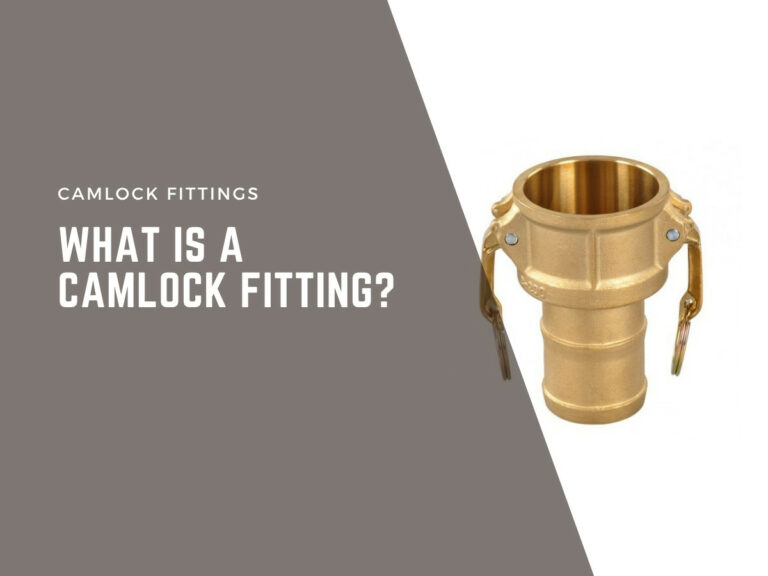
Camlock selection is a function of service medium, pressure rating, temperature, material compatibility, and the mating fitting on the other side of the transfer. This guide covers the eight standard types (A, B, C, D, E, F, DC, DP), the material trade-offs, and the gasket selection that governs chemical compatibility.
Material, size, type, and pressure rating are the main factors that will influence your decision to get the ideal camlock fittings. The team at Simlecco has put together this guide to help you specify the correct fitting for your application and avoid leaks, broken pipes, or incompatible assemblies.
Factors That Impact Your Camlock Fittings Selection
The correct camlock material will suit the fluid or gas you work with. Generally, stainless steel, brass, and aluminum are used to manufacture camlock fittings. Your Simlecco representative can advise on the best material for your manufacturing or commercial requirements, including correct sizing of the tubes or pipes you plan to connect.
The next sections cover the eight standard types (A, B, C, D, E, F, DC, and DP), pressure ratings, and material compatibility based on the medium transported in your hoses or pipes.
Select Your Camlock Fitting Material
The cam-and-groove design of camlock fittings allows rapid hose and pipe connection. The body material varies by application. Here is an overview of Simlecco camlocks against common service categories:
- Aluminum: Lightweight and suitable for general-purpose transfer. Not suitable for corrosive chemicals.
- Stainless steel: High corrosion resistance and durability. Used across general industrial service.
- Brass: Durable and suitable for water-distribution applications.
- Polypropylene: Chemical-resistant for specific applications. Confirm with your Simlecco representative whether polypropylene is appropriate for your service.
- Carbon steel: Carbon steel camlocks are economical for general petroleum-product transfer at moderate pressures. For sour service (H₂S-bearing crude or gas), carbon steel requires NACE MR0175:2021 compliance — controlled hardness, specific heat treatment. Stainless 316L is the safer specification when sour-service compatibility is unclear. Pair with industrial hoses for oil and gas.
Determine the Size You Need
Specify the hose or pipe size before ordering your camlocks. Confirm material tolerances and flow requirements as part of the same specification step.
SIZING NOTE: Camlock fittings are sized to the nominal hose ID (not the tube/hose outside diameter). Specify the nominal size per A-A-59326 / EN 14420-7 — for example, a 2″ camlock pairs with a 2″ nominal-ID hose, regardless of the hose’s outer diameter. Sizing to OD is a common procurement error that produces incompatible assemblies.
Know the Correct Temperature Ratings
The gasket typically governs the service temperature rating. Metal camlock couplings are generally more heat resistant than polymer bodies. Polypropylene camlock fittings carry typical service ratings around 70°C continuous (158°F); higher temperatures soften the body. Match the gasket to the chemistry and temperature: NBR for general petroleum-based service to ~100°C; EPDM for water, steam, and aggressive chemistry (not for petroleum); FKM (Viton) for fuel and high-temperature service to ~200°C; PTFE for aggressive chemical compatibility.
Consider Flow Requirements
Determine flow requirements against the manufacturer’s specifications for your hoses, tubes, or pipes, then select camlocks that support the required flow rate. As a rule of thumb, larger-diameter tubing supports higher flow rates. Confirm that the fittings you specify are compatible with the rest of the assembly.
Pick the Right Type of Fitting
Camlocks provide rapid hose and pipe connection. Specifying the correct cam-and-groove type for the mating fitting is critical — a Type A adapter pairs with a Type B, C, or D coupler, not with another adapter.
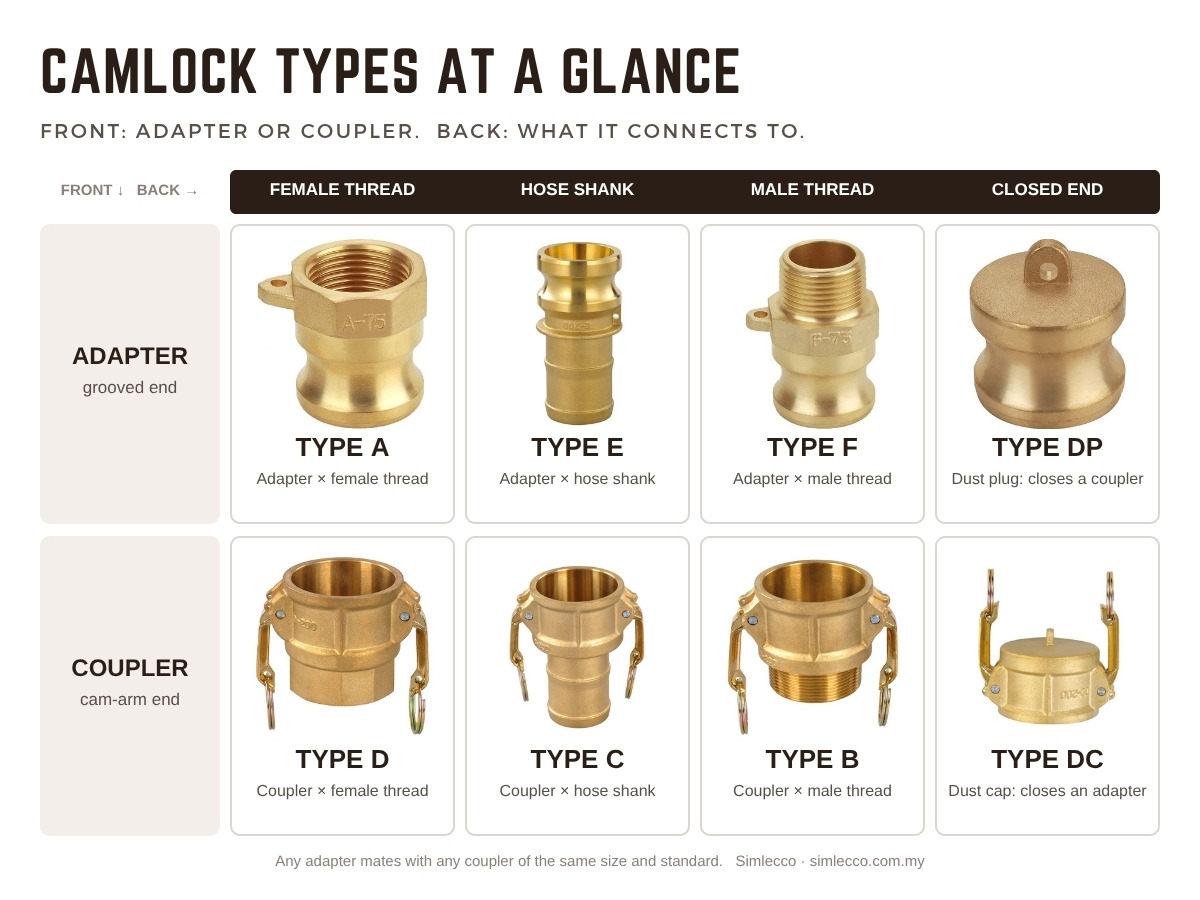
The types of camlock fittings available at Simlecco include the following:
- Type A: male adapter with female NPT thread.
- Type B: female coupler with male NPT thread.
- Type C: coupler with hose shank.
- Type D: coupler with female cam arms x female NPT thread.
- Type E: adapter with male cam profile x hose shank.
- Type F: adapter with male cam profile x male NPT thread.
- Dust Cap (DC): female cam-arm body, no through-bore. Caps any male adapter.
- Dust Plug (DP): male grooved plug, no through-bore. Plugs any female coupler.
Type A adapters couple a hose-end to a threaded pipe. Type B couplers join a threaded pipe to a male camlock adapter. Type C couplers pair with Type E adapters on hose-to-hose transitions. Type D couplers terminate at a female NPT thread for fixed-pipe service.
Type E adapters mate with Type C couplers on hose-shank assemblies. Type F adapters mate with Type B couplers on male-thread to cam-profile transitions. DC dust caps fit over male adapters; DP dust plugs seat inside female couplers.
Check the Pressure Rating
High-pressure camlocks support service in pressurised liquid or gas systems. Confirm with the Simlecco team that the selected fitting rating envelopes your operating pressure with appropriate safety margin for personnel and equipment protection.
Specify Your Camlock Fitting with Simlecco
A Simlecco camlock specialist can advise on type, size, material, and gasket selection against your service envelope. Our guide to evaluating industrial hose suppliers applies here too. We start by characterising your service conditions and then narrow the specification to a fitting compatible with the entire transfer assembly.
Contact Simlecco to specify camlock fittings for your application.