- Common Suction Problems at a Glance
- NPSH in Plain Language
- The Five Things to Check When Suction Fails
- 1. Reservoir fluid level
- 2. Suction strainer or filter restriction
- 3. Suction line routing and size
- 4. Fluid vapour pressure (temperature)
- 5. Air ingress on the suction side
- Cavitation Versus Air Gulping: Telling Them Apart
- Suction Hose Specification
- Diagnostic Decision Matrix
- When to Call Your Engineer
- FAQ
- What is the NPSH margin I should design for?
- Can a pressure hose be used on the suction side?
- Does Malaysian ambient temperature matter for NPSH?
- How do I confirm air ingress versus cavitation?
- Source Suction Hose and Fittings from Simlecco
Most hydraulic suction problems trace back to Net Positive Suction Head (NPSH). If the suction head available to the pump (NPSHa) drops below what the pump datasheet requires (NPSHr), the fluid flashes into vapour at the impeller and the pump cavitates. The fix is rarely a new pump; it is usually a fluid-level correction, a clean strainer, a shorter suction line, a cooler fluid temperature, or a sealed air ingress point. This guide gives Malaysian plant engineers a defensible diagnostic order aligned with ISO 4413 and SAE J517:2021.
Simlecco holds vacuum-rated suction hose and DK-Lok fittings sized for the suction side of Malaysian hydraulic packages. Before specifying a replacement hose, work the NPSH checks below; the hose is rarely the root cause.
Common Suction Problems at a Glance
If you have heard one of these symptoms in the field, the diagnostic below maps each to its NPSH check.
- Cavitation noise (rattling, popping near the pump) — NPSHa has dropped below NPSHr; vapour bubbles are forming and collapsing on the impeller.
- Loss of prime / no flow on startup — air gulping at the suction side; reservoir level below the pump centreline.
- Foaming reservoir — air return entrained at the case drain; fluid temperature too high; vortex at the suction inlet.
- Slow pressure build / slow ramp-up — viscosity high at cold start; restriction in the suction line; partial blockage at the strainer.
- Intermittent flow / pulsing — alternating air ingress; cyclic strainer clog (fibre, sludge).
- Pump overheating — fluid not returning at adequate flow; closed suction valve; vapour pressure exceeded at the suction.
Each of these symptoms traces to one of five root causes in the NPSH framework. The diagnostic checks below are how a field engineer isolates the cause from the symptom.
NPSH in Plain Language
NPSH is the suction-side energy balance of the pump. NPSHa is what the system delivers to the pump inlet; NPSHr is what the pump needs to avoid cavitation, taken from the manufacturer datasheet at the relevant flow.
The rule of thumb: NPSHa should exceed NPSHr by at least 3 ft (about 1 m) under worst-case operating conditions. If the margin is thinner, any small disturbance (warm fluid, dirty strainer, low reservoir) tips the pump into cavitation.
NPSHa is built from four terms: atmospheric pressure on the reservoir surface, plus static suction head if the reservoir sits above the pump, minus friction loss in the suction line, minus the vapour pressure of the fluid at operating temperature. Anything that reduces the first two or increases the last two reduces NPSHa.
The Five Things to Check When Suction Fails
1. Reservoir fluid level
Fluid level below pump centreline immediately erases static suction head and pushes NPSHa toward deficit. Top up to the high-level mark and recheck before doing anything else.
If level falls again quickly, the system has an external leak or an internal bypass that needs tracing before further suction-side work.
2. Suction strainer or filter restriction
A clogged suction strainer behaves like a closed valve from the pump’s point of view: it converts the static head into friction loss. Remove the strainer, inspect mesh integrity and clean or replace.
If the strainer keeps clogging, sample the reservoir fluid for ISO 4406 cleanliness. The root cause is upstream contamination, not the strainer itself.
3. Suction line routing and size
Long horizontal runs, undersized lines and unnecessary elbows all add friction loss that NPSHa cannot afford. Compare the installed line size against the pump OEM recommendation and the original schematic.
If the line is correctly sized but routing was changed during a previous repair, restore the original layout. Reroute to minimise length and elbow count, and slope the line gently upward toward the pump to prevent air pockets.
4. Fluid vapour pressure (temperature)
Vapour pressure rises sharply with temperature. A hydraulic mineral oil that is happy at 50 C may cavitate the same pump at 75 C because the vapour pressure term has grown.
Check the reservoir thermometer and the cooler. A failed cooler, fouled tubes or a stuck thermostatic bypass will warm the fluid enough to push the pump into cavitation on a hot Malaysian afternoon.
5. Air ingress on the suction side
Anywhere on the suction side that sits below atmospheric pressure will pull air in through a loose fitting, a porous hose cover or a low fluid level above the suction strainer. Air gulping mimics cavitation: the same noise, the same loss of prime, often a different root cause.
Inspect every joint from the reservoir to the pump. Tighten to the fitting manufacturer torque (after depressurising), replace damaged O-rings, and confirm the suction hose cover has no cuts or abrasion.
Cavitation Versus Air Gulping: Telling Them Apart
| Symptom | Cavitation (vapour collapse) | Air gulping (air ingress) |
|---|---|---|
| Noise | Sharp, rattling, “marbles in the pump” | Gurgling, intermittent |
| Fluid in reservoir | Looks normal | Foaming, milky appearance |
| Discharge gauge | Erratic, drops under load | Sawtooth fluctuation |
| Typical cause | NPSHa < NPSHr (hot fluid, clogged strainer, low level) | Loose fitting, low level uncovering suction, porous hose |
| First action | Cool the fluid, clean the strainer, raise the level | Pressure-test the suction side; tighten and reseal |
Suction Hose Specification
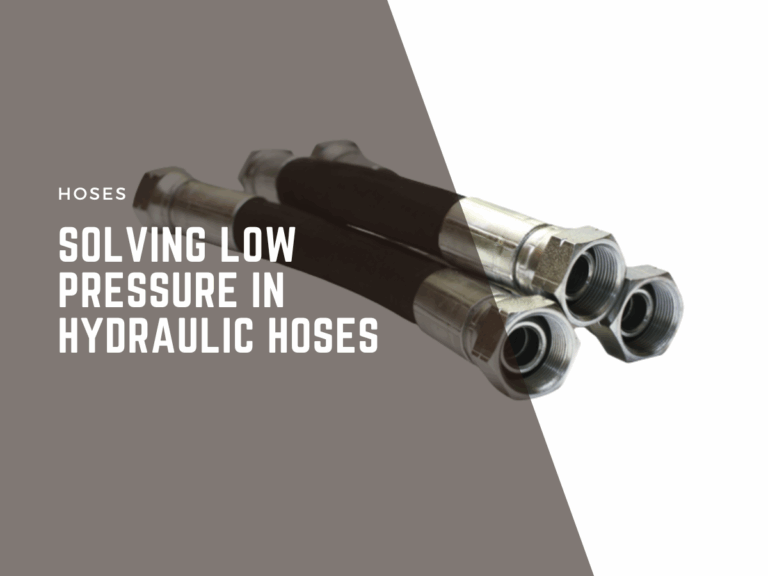
Suction hose is not the same as pressure hose. It must be vacuum-rated to resist collapse, helix-reinforced for full-vacuum service, and sized to keep flow velocity in the 0.6 to 1.2 m/s band recommended by most pump OEMs.
For hydraulic suction and return service, SAE 100R4 per SAE J517:2021 is the workhorse spec: textile-reinforced with an embedded helix wire, rated for vacuum service. Substituting a discharge-rated hose (R1, R2) on the suction side risks tube collapse under vacuum even though the working-pressure number looks more impressive.
- Confirm full-vacuum capability (typically expressed as “29 inHg” or “full vacuum”).
- Match nominal ID to the pump OEM suction port; do not undersize.
- Use swept-radius elbows and the original line length; do not coil excess hose to “use up” length.
- Support the hose at intervals consistent with the manufacturer guidance; an unsupported hose sags and traps air.
Diagnostic Decision Matrix
| Observation | Likely cause | Action |
|---|---|---|
| Noise after fluid warms up | Vapour pressure rise; failed cooler | Service the cooler; verify thermostatic bypass |
| Noise that improves after strainer service | Suction restriction | Schedule shorter strainer intervals; sample for ISO 4406 |
| Foaming reservoir | Air ingress on suction side | Pressure-test joints; replace suction hose if porous |
| Pump loses prime on start | Low fluid level or suction line drains back | Refill; fit a foot valve or anti-siphon as appropriate |
| Persistent cavitation after all checks | Pump wear; impeller damage | Stop and call your engineer for pump overhaul or replacement |
When to Call Your Engineer
If cavitation noise persists after the five checks above are clean, the pump itself may be worn. Internal clearances open up over time, NPSHr rises, and a pump that was happy at installation now demands more head than the system can deliver. Call your engineer for an internal inspection or replacement.
Also escalate any change in suction noise that coincides with a fluid change, a reservoir top-up with the wrong grade, or a recent piping modification. These are common root causes that maintenance teams miss because the change was “minor”.
FAQ
What is the NPSH margin I should design for?
Industry benchmarks suggest at least 1 m (3 ft) of NPSHa above NPSHr at worst-case fluid temperature and flow. Tight margins fail first when conditions drift.
Can a pressure hose be used on the suction side?
No. Pressure hose is designed to resist internal pressure pushing the wall outward, not vacuum pulling it inward. Use a vacuum-rated, helix-reinforced construction such as SAE 100R4 per SAE J517:2021.
Does Malaysian ambient temperature matter for NPSH?
Yes. Higher ambient drives higher reservoir temperature, which raises vapour pressure and reduces NPSHa. Specify cooler capacity for worst-case afternoon conditions, not annual averages.
How do I confirm air ingress versus cavitation?
Look at the reservoir. Foaming or milky fluid suggests air ingress; clear fluid with the marbles-in-the-pump sound suggests vapour cavitation. The cavitation-versus-air-gulping table above gives more detail.
Source Suction Hose and Fittings from Simlecco
At Simlecco we stock vacuum-rated suction hose, DK-Lok instrumentation fittings and the related industrial fittings to rebuild a suction side cleanly. Send your pump OEM datasheet, the original line size and your fluid type, and we will quote a like-for-like or upgraded replacement that meets SAE J517:2021. Browse our industrial hose range or industrial fittings to start.
Disclaimer: this article is general guidance for procurement and maintenance planning. It does not replace site-specific risk assessment, the pump OEM service manual or the judgement of a competent hydraulic engineer. Work on hydraulic systems must comply with the OSH (Amendment) Act 2022, ISO 4413 and your plant’s permit-to-work procedures.