- What is an instrument valve?
- The 8 DK-Lok instrument valve types
- 1. Needle valves
- 2. Gauge-root valves
- 3. Instrument ball valves
- 4. Two-valve manifolds (2V)
- 5. Three-valve manifolds (3V)
- 6. Five-valve manifolds (5V)
- 7. Monoflange valves
- 8. Double-block-and-bleed (DBB) instrument valves
- Selection: matching the valve to the application
- Q1: What is the service?
- Q2: What is the operating pressure and temperature?
- Q3: What is the process medium?
- Q4: What is the installation envelope?
- Material grades and what they mean
- The DOSH compliance angle for instrumentation
- Sourcing checklist
- Local stock vs the 12-week import trap
- Stakeholder note: the instrumentation engineer’s perspective
- Frequently asked questions
- What is the difference between an instrument valve and a process valve?
- Are DK-Lok instrument valves compatible with other brands’ tube fittings?
- Which manifold configuration do I need for a DP transmitter?
- What is the typical lead time for instrument valves in Malaysia?
- 1-Minute decision checklist
- Need instrument valves for a Malaysian plant?
Instrument valves are the small-bore, precision-machined valves that interface process equipment with the instrumentation that measures and controls it — pressure gauges, transmitters, flow meters, analyser feeds, sample stations. Think of them as the dimmer switches and circuit breakers of an instrumentation hookup: they regulate, isolate, and protect the signal path between process and instrument.
In a Malaysian O&G plant, instrument valves outnumber process valves by an order of magnitude, and their failure modes, small leaks, stem packing wear, frozen actuation, are responsible for most of the hidden maintenance overhead. If you specify or maintain instrumentation hookups on a Malaysian plant, this guide covers the eight DK-Lok instrument valve types, how to select the right one, the material grades that matter, and the DOSH-compliant sourcing discipline that keeps the audit trail intact.
What is an instrument valve?
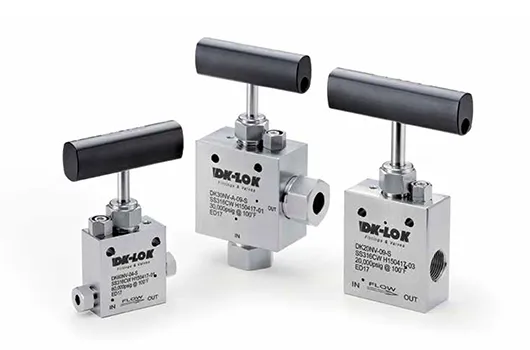
An instrument valve is purpose-built for low-flow, high-precision service in instrumentation hookups. Three characteristics distinguish them from process valves:
- Small bore. Typical sizes run from 1/8″ to 1″: sufficient to isolate or modulate the instrument tap, not sized for process flow.
- High-pressure capability. Most are rated 6,000 psig or higher at room temperature, well above the operating pressure of the instrumentation they protect.
- Precision actuation. Hand-wheel or lever operation with fine throttling capability for sampling, venting, or zero-flow shutoff.
Instrument valves typically install in clusters, isolation valve, vent valve, calibration tap, drain, on a single instrumentation hookup. The combined assembly is the manifold.
The 8 DK-Lok instrument valve types
DK-Lok manufactures a unified family of instrument valves designed to interface with the company’s twin-ferrule tube fittings. The eight types cover the application space encountered in instrumentation hookups.
1. Needle valves
Precise throttling service. The tapered stem mates against the seat to give fine control over low flow. Application: pressure gauge isolation, sample take-off, calibration tap. DK-Lok needle valves rate 6,000 psig at room temperature in 316 stainless steel.
2. Gauge-root valves
Compact two-port valve at the base of a pressure gauge. Isolates the gauge for replacement or calibration without depressurising the process line. Often with built-in venting port.
3. Instrument ball valves
Quarter-turn shutoff for fast, reliable isolation. Used where fine throttling is not required and rapid open/close is preferred. The seat seal makes them well-suited to gas service.
4. Two-valve manifolds (2V)
A block-and-bleed configuration: one isolation valve, one vent. Primary application: single-port pressure transmitter isolation.
5. Three-valve manifolds (3V)
Two isolation valves plus a connecting equalisation valve. Application: differential pressure transmitters — equalises the two sense lines for transmitter zero, then isolates each line independently for maintenance.
6. Five-valve manifolds (5V)
Two isolation valves, one equalisation valve, two vent valves. Application: DP transmitters in service where atmospheric venting is required during transmitter calibration or maintenance.
7. Monoflange valves
A single-block valve assembly combining two or three isolation functions into one body. Compact alternative to a discrete manifold. Common in space-constrained installations.
8. Double-block-and-bleed (DBB) instrument valves
Two independent in-line isolation seats with a bleed port between them. Used where positive isolation must be proven to the auditor — sample stations, chemical injection points, instrument hookups on critical service. See our Double Block and Bleed Valves guide for the DOSH-compliance argument.
Selection: matching the valve to the application
The selection logic for instrument valves proceeds through four questions.
Q1: What is the service?
Pressure measurement, flow measurement, sampling, chemical injection, or instrument calibration. The service dictates the configuration — for instance, DP transmitters require 3V or 5V manifolds; gauge isolation needs needle or gauge-root; sample take-off needs needle (for throttling) or DBB (for proven isolation).
Q2: What is the operating pressure and temperature?
The valve’s rated pressure-temperature curve must envelop the actual operating envelope, not the room-temperature MAWP. High-temperature service degrades elastomer-seated valves; specify metal-seated configurations above 200°C.
Q3: What is the process medium?
Hydrocarbon service permits standard 316 stainless steel. Sour service (H₂S above the NACE MR0175:2021 threshold) requires NACE-compliant material with controlled hardness. Chloride-bearing service may require Monel or Hastelloy. Oxygen service requires factory oxygen-cleaning protocols (covered separately).
Q4: What is the installation envelope?
Space-constrained installations favour monoflange configurations over discrete manifolds. Vibration-prone installations favour higher-mass valve bodies and reinforced packing.
Material grades and what they mean
For instrumentation valves on critical O&G service, three material baselines cover the majority of applications:
| Service | Material baseline | Standard |
|---|---|---|
| General hydrocarbon, moderate temperature | SS316/SS316L | ASTM A276:2017 |
| Sour service (H₂S exposure) | SS316L per NACE | NACE MR0175:2021 |
| High-chloride or aggressive corrosion | Monel 400 or Hastelloy C276 | ASTM B164 / B574 |
Soft-seat materials (PTFE, RPTFE) are appropriate for low-temperature service. Higher temperature (>180°C) or steam service requires metal-seated configurations.
The DOSH compliance angle for instrumentation
Instrument valves do not always receive the same audit scrutiny as process valves, but they should. Three audit-defensibility points apply:
- MTR per valve. Every instrument valve on critical service should have a Material Test Report tying its body alloy to a certified mill batch. DK-Lok ships MTRs with every consignment through Simlecco.
- Pressure-test records. Every body must pass API 598:2023 seat-leakage and shell-pressure testing at the factory. The test record should be retrievable by serial number or batch.
- Hookup-level documentation. The audit trail extends from valve to manifold to transmitter: the complete instrumentation hookup. Each valve’s documentation should be filed against the line item it protects.
For full requirements, see DOSH Malaysia.
Sourcing checklist
Before issuing the purchase order for an instrumentation valve consignment:
- Specify type and configuration. Use the type list above; include the manifold valve count (2V/3V/5V) for DP applications.
- Confirm material grade. Match service conditions; for sour service, explicitly require NACE MR0175:2021 compliance.
- Confirm pressure-temperature rating. Specify the operating envelope, not just the room-temperature MAWP.
- Confirm end connections. Match the existing tube-fitting standard exactly (DK-Lok twin-ferrule, NPT, BSPP, etc.).
- Require MTR with the shipment. Do not accept “MTR available on request after delivery”: request it as part of the PO terms.
- Require API 598:2023 test records. Per serial number.
- Verify chain of custody. Source through the authorised distributor: for DK-Lok in Malaysia, that is Simlec Co Sdn Bhd, supplying direct customers and an authorised dealer network.
Local stock vs the 12-week import trap
Instrument valves on critical service are the worst category to back-order. A single missing needle valve can hold up commissioning of an entire instrumentation rack. Sea-freight lead times from Asian manufacturing hubs to Malaysian ports run 12–16 weeks for specialty configurations; air-freight runs at 8–15× the standard shipping cost.
Simlecco maintains in-country stock of DK-Lok instrument valves across the common configurations (needle, gauge-root, instrument ball, 2V/3V/5V manifolds) in SS316L. For inventoried sizes, dispatch is typically within a business day. For non-inventoried configurations, the standard 12-week or more import path applies, which is why scheduled-turnaround planning should always front-load the unusual configurations.
Stakeholder note: the instrumentation engineer’s perspective
The instrument valve specification is usually the least-reviewed line on the procurement schedule, and the most likely to cause a commissioning delay. Front-load the unusual configurations during pre-FEED; standardise on a single brand for the common configurations; and ensure the authorised distributor’s local stock list is appended to the specification. That alone eliminates 80% of the late-stage substitution requests.
Frequently asked questions
What is the difference between an instrument valve and a process valve?
Instrument valves are small-bore (1/8″ to 1″), high-pressure rated, and designed for instrumentation hookups — pressure gauges, transmitters, sample stations. Process valves carry the actual process flow and are sized for the line. The two categories use different design references and different testing standards.
Are DK-Lok instrument valves compatible with other brands’ tube fittings?
Twin-ferrule tube fittings from different manufacturers are not designed to intermix; replace a DK-Lok joint with DK-Lok components per the manufacturer’s installation guide. The brand-mixing failure mode is well-documented on engineering forums — an Eng-Tips discussion on Swagelok twin-ferrule fittings in low-pressure service notes that even sub-100-psi installations creep and weep when ferrules and bodies from different manufacturers are mixed. ISO 8434-1:2007 covers mating dimensions for metric 24° cone connectors but does not qualify a cross-brand joint for service. For HP service and sour service, standardise on a single brand and validate the complete assembly per NACE MR0175:2021.
Which manifold configuration do I need for a DP transmitter?
A 3-valve manifold is standard for differential pressure transmitters. The two isolation valves close the sense lines; the equalisation valve zeros the transmitter for calibration. Add a 5-valve manifold if the transmitter requires atmospheric venting during maintenance.
What is the typical lead time for instrument valves in Malaysia?
Days from local stock for standard configurations through Simlecco; 12–16 weeks via sea freight for non-inventoried specialty configurations.
1-Minute decision checklist
Need instrument valves for a Malaysian plant?
Simlecco stocks DK-Lok instrument valves, needle, gauge-root, ball, 2V/3V/5V manifolds, monoflange, DBB, in SS316L with full MTR and API 598:2023 documentation. Click the WhatsApp button on this page to discuss your specification, or fill in the contact form and we will respond within one business day.
Disclaimer: All brand names mentioned are trademarks of their respective holders.