- Introduction: The Root Cause of Bad Data
- Why Many Specifications Fail (The Distributor Gap)
- Anatomy and Core Functions
- The 3-Valve Manifold (Isolation & Equalization)
- The 5-Valve Manifold (The Calibration Standard)
- Standard 5-Valve Isolation, Calibration, and Restoration Procedure
- Quick Reference: 3-Valve vs 5-Valve Comparison
- Cross-Brand Interchangeability & Legacy Replacements
- How to Choose the Right Assembly for Your Plant
- 1. What is the process media?
- 2. What are the calibration, regulatory, and budget needs?
- Critical Safety Note: Engineering Controls & DOSH Compliance
- Frequently Asked Questions (FAQ)
- 1. Can a 3-valve manifold be upgraded in the field?
- 2. What is the difference between an Isolation Valve and an Equalizer?
- 3. Are 5-valve assemblies always the better choice?
- 1-Minute Decision Checklist
Understanding the differences between 3-valve and 5-valve instrument manifolds is critical for safe differential pressure calibration. A 3-valve manifold provides isolation and equalization for basic service. Conversely, a 5-valve manifold used in differential pressure transmitter assemblies adds two vent/test valves. This allows for safe depressurization without removing the instrument, acting as a critical engineering control for DOSH-regulated high-pressure lines in Malaysia.
Introduction: The Root Cause of Bad Data
When a differential pressure transmitter shows unstable readings in a Kerteh gas terminal, the root cause is typically the manifold selection or installation arrangement, not a transmitter costing several thousand ringgit.
A mismatched manifold leads to trapped pressure, unsafe venting practices, and maintenance work that takes hours instead of minutes. In critical process loops, measurement errors lead directly to process inefficiency, yield loss, or worse, a reportable safety incident.
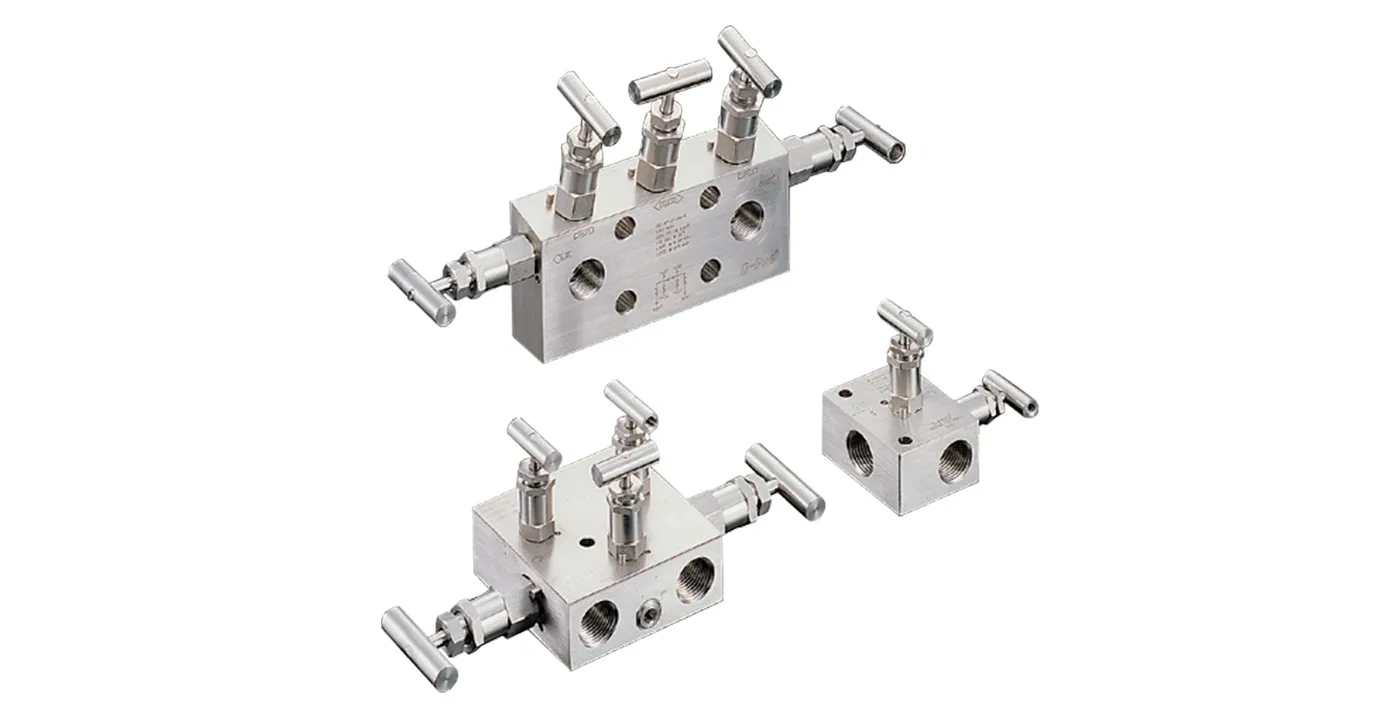
An instrument manifold is a compact metal assembly that links a process line to a measuring device. It consolidates multiple flow paths into a single body so technicians can isolate, equalize, and vent the instrument without breaking process containment.
The number of valves required depends entirely on your process safety and calibration requirements. Your choice dictates how safely your team can purge a line and how much downtime your plant faces.
Why Many Specifications Fail (The Distributor Gap)
Many suppliers fail because they treat instrument manifolds as standard pipe fittings.
They supply whatever is cheapest on the BOM without understanding the calibration requirements of the plant. Common errors include:
- The “Domestic” Mistake: Confusing industrial components with residential ones. A plant buyer searches for a generic term and gets quoted a plastic 5-valve irrigation manifold, an Orbit 5-valve manifold for sprinklers, or a Ducane 5-burner LP propane valve assembly. We strictly supply high-pressure, process-grade components for hazardous O&G environments, not domestic gas appliances.
- Material Mismatch: Supplying standard 316SS for offshore platforms in Labuan, where severe chloride pitting requires alloy upgrades.
- The Venting Hazard: Supplying 3-valve manifolds for high-pressure gas without dedicated venting arrangements. Technicians are forced to loosen the transmitter flanges to vent the system—a significant safety risk.
At Simlecco. (Simlecco), we audit the P&ID to ensure the manifold type matches the process media and your maintenance protocols.
Anatomy and Core Functions
To understand the 3-valve vs 5-valve instrument manifold differences, we must look at how they control pressure around the transmitter. In any standard 5-valve manifold diagram, the flow paths define the pressure control behaviour.
The 3-Valve Manifold (Isolation & Equalization)
This assembly contains three valves controlling the pressure paths:
- High-Pressure Isolation Valve: Blocks the high side from the process.
- Low-Pressure Isolation Valve: Blocks the low side from the process.
- Equalizer Valve: Sits between the high and low passages.
How it works: During normal operation, each isolation valve is OPEN and the equalizer is CLOSED.
To safely perform a routine “Zero Check” and protect the delicate sensing diaphragm from over-range pressure, the technician must follow this exact sequence:
- Open the equalizer valve to equalize pressure across the transmitter.
- Close the high-pressure (HP) block valve.
- Close the low-pressure (LP) block valve.
The Limitation: Standard 3-valve versions typically have no built-in vent ports. If you need to safely bleed off trapped fluid, you typically have to loosen process connections.
The 5-Valve Manifold (The Calibration Standard)
A 5-valve manifold configuration builds on the 3-valve layout by adding two crucial components. Whether you are matching a Yokogawa, Schneider, or Rosemount transmitter setup, the structure remains the same:
- Two Block Valves
- One Equalizer Valve
- High-Side Vent/Test Valve
- Low-Side Vent/Test Valve
5-Valve Manifold Operation: During normal measurement, the block valves are OPEN, while the equalizer and both vent valves are CLOSED.
The Advantage: When executing a proper 5-valve manifold isolation procedure, the technician can safely depressurize the unit. They can then connect calibration equipment to the vent/test ports to apply a known pressure to the transmitter without ever removing it from the line.
Standard 5-Valve Isolation, Calibration, and Restoration Procedure
Always verify line isolation and follow site-specific Lockout/Tagout (LOTO) procedures.
Phase 1: Isolation & Equalization
- Open the equalizer valve to protect the transmitter diaphragm.
- Close the high-pressure (HP) block valve.
- Close the low-pressure (LP) block valve.
Phase 2: Venting & Calibration
- Slowly open the vent/test valves to safely depressurize trapped media.
- Connect calibration equipment to the test/vent ports for in-place verification.
Phase 3: Restoration to Active Service
- Close the vent/test valves.
- Close the equalizer valve.
- Open the high-pressure (HP) block valve.
- Open the low-pressure (LP) block valve.
Quick Reference: 3-Valve vs 5-Valve Comparison
| Feature | 3-Valve Manifold | 5-Valve Manifold |
| Isolation | ✅ Yes | ✅ Yes |
| Equalization | ✅ Yes | ✅ Yes |
| Venting Capability | ❌ No | ✅ Yes |
| In-place Calibration | ❌ No | ✅ Yes |
| Suitable for Gas Service | ⚠️ Limited | ✅ Recommended |
| Maintenance Downtime | High | Low |
Cross-Brand Interchangeability & Legacy Replacements
Many Malaysian plants are locked into legacy brands from their original EPC contracts. If you are looking to replace a Swagelok, Parker, Oliver, PGI, or Anderson Greenwood manifold, it is critical to know that many modern manifolds are designed around IEC 61518 mounting dimensions (54mm center spacing).
This standardizes mounting dimensions between differential pressure instruments and flanged shut-off devices, which often allows for direct replacement across brands. However, exact compatibility must still be verified model-by-model against pressure ratings and adapter styles to ensure a safe, NACE-compliant replacement.
How to Choose the Right Assembly for Your Plant
When upgrading lines or building new skids, use this framework to decide between the two designs:
1. What is the process media?
- Low-Risk Liquids (Water/Lube Oil): A 3-valve manifold is often sufficient. Ambient-temperature liquids present a lower venting hazard profile compared to expanding gases, and standard zero-checks usually meet calibration needs.
- Gas, Steam & High-Temperature Fluids: 5-valve manifolds are strongly recommended. Gas, steam, and high-temperature fluids (e.g., hot oil near or above its flash point) must be safely and controllably vented away from the operator before calibration.
2. What are the calibration, regulatory, and budget needs?
- Standard Monitoring: If you only zero the transmitter during an annual shutdown in standard utility sectors, a 3-valve unit is cost-effective.
- Custody Transfer & High Compliance: In Pengerang petrochemical zones, strict quality systems demand frequent, documented multi-point calibrations. A 5-valve manifold setup cuts calibration time from hours down to 15 minutes.
- Cost of Ownership: Saving RM100 on upfront capital expenditure is meaningless if the unit lacks vent ports, forcing your maintenance team into hours of unsafe, labor-intensive flange breaking.
Critical Safety Note: Engineering Controls & DOSH Compliance
Why Safe Venting Procedures Matter:
Under Malaysia’s Occupational Safety and Health Act 1994 (Act 514), employers bear a duty to provide and maintain plant and systems of work that are safe and without risks to health.
If a technician is injured venting high-pressure gas because the manifold lacked dedicated test valves (forcing them to loosen live fittings), the incident will be assessed against the employer’s duty to provide a safe system of work. Specifying 5-valve manifolds for hazardous gas service is a proactive engineering control that eliminates exposure to live pressure by design, demonstrating legal due diligence.
Frequently Asked Questions (FAQ)
1. Can a 3-valve manifold be upgraded in the field?
No. The two designs use completely different machined body castings. You cannot drill or add ports to a pressure-rated block in the field; doing so voids the rating and is a severe safety violation.
2. What is the difference between an Isolation Valve and an Equalizer?
Isolation valves (blocks) isolate the entire instrument from the live process pressure. The Equalizer connects the high and low chambers inside the manifold. Opening the equalizer ensures the delicate sensing diaphragm isn’t over-ranged or exposed to excessive differential pressure.
3. Are 5-valve assemblies always the better choice?
Not necessarily. While they offer more functionality and are highly preferred in critical process control, they can be over-specified for simple, low-risk liquid monitoring where space is tight. Match the manifold to the hazard profile of your fluid.
1-Minute Decision Checklist
Before finalizing your instrumentation BOM, verify these 4 points:
- Media Check: Is the process fluid a Gas, Steam, or Hot Oil? (If yes, specify the 5-valve design).
- Calibration Plan: Do you require in-place multi-point calibration? (If yes, use a 5-valve design).
- Material Spec: Have you verified the chloride/corrosion risk? (If offshore/Labuan, specify upgraded alloys like Alloy 625 or Duplex SS).
- Mounting Pattern: Does the transmitter require IEC 61518 54mm center spacing? (Verify exact mating dimensions against the datasheet).
CTA: Avoid measurement errors and unsafe venting conditions. Contact our technical team to cross-reference your legacy manifolds or browse our range of process-grade DK-Lok instrument manifolds.
Disclaimer: All brand names mentioned are trademarks of their respective holders and are used here for identification purposes only.