- How a Solenoid Valve Works
- The 7 Selection Criteria
- 1. Fail-safe state: NC or NO
- 2. Direct-acting vs pilot-operated
- 3. Cv sizing
- 4. Pressure-temperature envelope
- 5. Body and seal material
- 6. Coil voltage and AC vs DC trade-offs
- 7. Ingress protection and explosion rating
- Cv Sizing Worked Example
- Common Solenoid Valve Mistakes
- Selection Checklist
- FAQ
- AC or DC coils for Malaysian service?
- What is the difference between IP and Ex ratings?
- Pulse duty or continuous duty?
- Sourcing from Simlecco
Specifying a solenoid valve comes down to seven criteria the datasheet either answers cleanly or buries: fail-safe state, pressure-differential capability, Cv, pressure-temperature envelope, body material, coil voltage, and ingress/explosion ratings. Get them right and the valve runs for years. This guide walks the criteria in order, gives a Cv sizing example, and lists the three mistakes that recur on every Malaysian O&G site visit.
How a Solenoid Valve Works
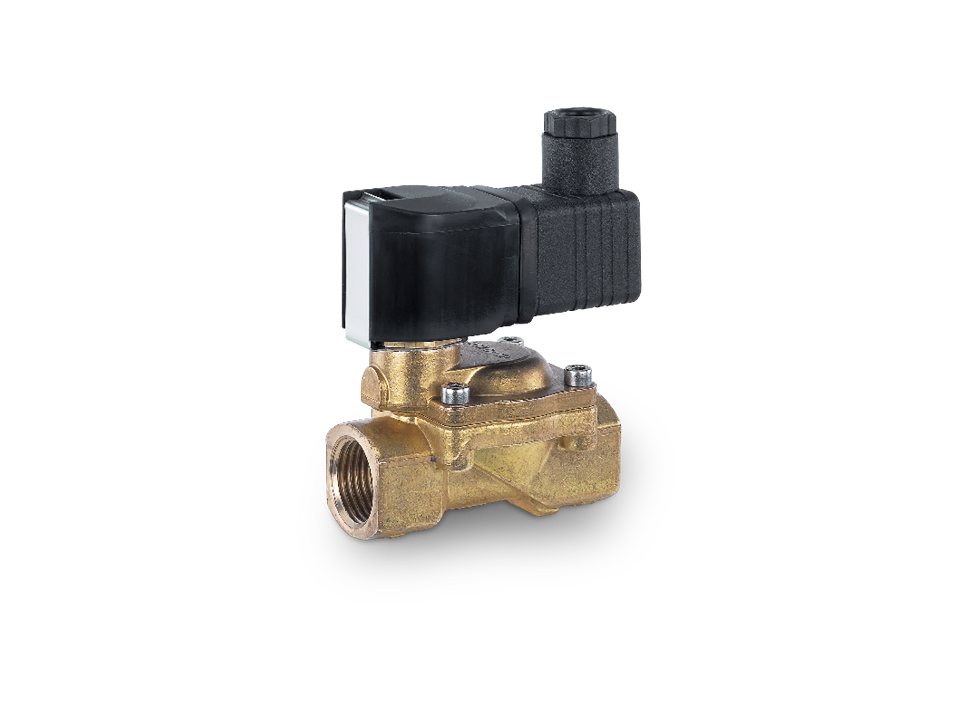
A solenoid valve converts an electrical signal into seat motion. Current through the coil generates a magnetic field that pulls a ferromagnetic plunger or armature against a return spring. The plunger motion opens or closes the valve seat directly. When the coil is de-energised, the spring returns the plunger to its fail-safe state.
Direct-acting solenoid valves move the plunger straight against the process pressure on the seat. They work down to 0 bar minimum ΔP, which suits vacuum and zero-pressure lines. The trade-off is coil size: the magnetic force has to overcome the full process pressure across the orifice, so coil wattage rises with orifice area.
Pilot-operated solenoid valves use the solenoid to control a small pilot port. Process pressure (typically at least 0.5 bar ΔP, confirm against the datasheet) does the heavy lifting on a main diaphragm or piston. Pilot designs handle large flows with a small coil but stall if the differential drops below the minimum threshold. AC coils show a brief inrush current spike at actuation; DC coils draw constant current, run cooler, and suit continuous duty. The choice affects panel sizing and continuous-duty thermal rating. Reference IEC 61518:2018 for instrumentation requirements and ANSI/ISA-75.01.01 for the Cv definition used in sizing.
The 7 Selection Criteria
1. Fail-safe state: NC or NO
The fail-safe state is the position the valve takes when power is lost. Choose it from the process safety case, not from the catalogue default.
- Normally closed (NC): power-to-open, fail-closed. For fuel gas, hazardous fluid isolation, fire-suppression release valves where loss of power should stop flow.
- Normally open (NO): power-to-close, fail-open. For cooling water, instrument air, breathing air where loss of power should keep flow going.
2. Direct-acting vs pilot-operated
Direct-acting valves move the seat with the solenoid plunger and work at 0 bar minimum ΔP. Pilot-operated valves use line pressure to actuate the main seat and typically require ≥0.5 bar ΔP across the seat to hold closed; verify the minimum ΔP against the specific datasheet, not a rule of thumb.
The choice drives orifice size, body size, and coil wattage. Pilot-operated valves let a small coil handle large flow; direct-acting valves handle low or zero ΔP at the cost of a bigger coil for the same orifice.
3. Cv sizing
Cv is the flow coefficient: the flow of water in US gpm at 1 psi ΔP at 60 °F. ANSI/ISA-75.01.01 is the controlling reference. As a working example: water at 1 bar ΔP through a valve of Cv 1.0 passes approximately 17 litres per minute.
Pick Cv to match the required flow at the actual operating ΔP, not at full line pressure. Undersizing Cv is the most common solenoid valve mistake: the valve opens, but the flow is throttled by the orifice and the downstream process starves.
4. Pressure-temperature envelope
Rated MAWP is published at room temperature. Derate to the operating temperature using the manufacturer’s curve, not the room-temperature number. For service above 80 °C, the seal material usually becomes the limiting factor before the body does.
5. Body and seal material
- Brass body: water, instrument air, general non-corrosive service.
- 316 stainless body: general industrial, coastal, chemical service.
- Seal material: match to chemistry: PTFE for broad chemical compatibility, FKM (Viton) for hydrocarbons and elevated temperature, EPDM for steam and hot water.
- Sour service: NACE MR0175:2021 compliance required; confirm body and trim hardness against the spec.
6. Coil voltage and AC vs DC trade-offs
AC coils draw a large inrush current at the moment of actuation, then drop to hold current. Size the starter and feeder for the inrush, not the hold. DC coils draw constant current, run cooler, and suit continuous-duty service.
In hot indoor or sun-exposed locations, DC is usually the safer pick on coil life. For frequent cycling, DC also avoids the AC humming caused by shaded-pole laminations.
7. Ingress protection and explosion rating
For Malaysian O&G service, this is where most catalogue valves get filtered out. Two separate ratings apply.
- IP65: minimum for outdoor industrial service. Dust-tight, water-jet protected.
- IP67: for wash-down or high-pressure cleaning environments. Survives temporary immersion.
- ATEX or IECEx certified: required for hazardous-area service. Specify gas group (IIA, IIB, or IIC) and temperature class (T1 to T6) from the area classification document.
- Ex d (flameproof) or Ex e (increased safety) per the protection concept on the area classification drawing. These are not interchangeable.
Cv Sizing Worked Example
Required flow: 50 litres per minute of water through a solenoid valve, available ΔP across the valve in the open position: 2 bar.
From the Cv definition, water flow Q (lpm) ≈ Cv × 14.42 × √(ΔP in bar) for cold water. Rearranging: Cv = Q / (14.42 × √ΔP) = 50 / (14.42 × √2) = 50 / 20.4 ≈ 2.5.
Select a valve with Cv ≥ 2.5 at the published rating. Headroom of around 20% covers manufacturing tolerance and service drift. Reference: ANSI/ISA-75.01.01 for the formal Cv equation.
Common Solenoid Valve Mistakes
- Undersized Cv: valve opens but the orifice throttles the flow, slow response, downstream process starves.
- Wrong fail-safe state: NO valve fitted on a fuel line, power outage leaves the line open.
- Missing Ex rating: a standard IP65 valve installed in a Zone 1 area, picked up at the next ATEX audit.
Selection Checklist
- Fail-safe state determined from the process safety case (NC or NO).
- Minimum ΔP across the seat known: direct-acting if it can hit zero, pilot-operated if always above the datasheet minimum.
- Cv calculated for required flow at actual ΔP, with 20% headroom.
- MAWP derated to operating temperature; seal material matches fluid chemistry.
- Body alloy correct for service; sour service confirmed NACE MR0175:2021 compliant.
- Coil voltage matches supply; AC inrush size verified or DC selected for continuous duty.
- IP rating ≥ environment requirement; ATEX/IECEx scheme matches area classification.
FAQ
AC or DC coils for Malaysian service?
DC coils run cooler and quieter and suit continuous duty in hot ambient conditions. AC coils give faster initial pull-in for snap-acting service but draw inrush current that has to be designed into the supply. For frequent-cycling or sun-exposed installations, DC is usually the longer-life choice.
What is the difference between IP and Ex ratings?
IP rating describes ingress protection against dust and water. Ex rating describes suitability for installation in a hazardous (potentially explosive) atmosphere. A valve can be IP67 without being Ex-rated. In a classified area you need both: the IP rating from the area’s water and dust exposure, the Ex rating from the gas group and temperature class.
Pulse duty or continuous duty?
Continuous-duty coils are designed to run energised indefinitely; pulse-duty coils are not. Specifying a pulse-duty coil on a process control loop that energises for hours is a coil burnout waiting to happen. Confirm the duty cycle on the datasheet matches the application.
Sourcing from Simlecco
Simlecco stocks and supplies a range of industrial solenoid valves for instrumentation and process service across Malaysian O&G, palm oil, and general industrial sites. For ATEX/IECEx hazardous-area selection, sour-service compliance, or Cv sizing on a difficult flow, contact our technical team with the seven criteria above and we will return a shortlist with datasheets attached. Reference standards: IEC 61518:2018, ANSI/ISA-75.01.01, ATEX 2014/34/EU, IECEx scheme.