- What a DBB valve actually does
- The DOSH compliance argument
- Where DBBs are required in Malaysian O&G
- 1. Sample stations
- 2. Chemical injection points
- 3. Instrument hookups on critical service
- DBB valve types: integral vs modular vs valve-train
- Integral DBB
- Modular DBB
- Valve-train DBB
- Material and pressure-rating selection
- Common Malaysian O&G applications
- Refinery sample stations
- Subsea umbilical chemical-injection
- Metering station block-and-bleed
- Sourcing checklist
- What goes wrong (and what to specify against it)
- 1. Block 1 seat erosion on sample service
- 2. Bleed port plugging on inhibitor service
- 3. Stem packing degradation on sour service
- Decision matrix at a glance
- Stakeholder note: the maintenance supervisor’s perspective
- Frequently asked questions
- Is a DBB the same as a single-block valve with a downstream drain?
- Can I use a DBB on any service?
- What is the difference between DBB and DIB (double isolation and bleed)?
- Do DK-Lok DBB valves include the bleed valve in the assembly?
- 1-Minute decision checklist
- Need a DBB valve for a Malaysian project?
A double-block-and-bleed (DBB) valve provides two independent in-line isolation seats with a bleed port between them — the simplest mechanical answer to the question “how do I prove this line is isolated for maintenance?” Think of it as a belt and braces with a witness tap: block 1 holds, block 2 backs it up, and the bleed between them shows you whether either is leaking in real time.
In Malaysian O&G operations, the DBB shows up at sample stations, chemical-injection points, and instrument hookups on critical service. It is the configuration the DOSH auditor expects to see whenever positive isolation must be demonstrable. If you specify isolation valves on a maintenance-critical line, this guide covers what a DBB does, where it is required, how to specify it, and how to source it without falling into the typical documentation traps.
What a DBB valve actually does
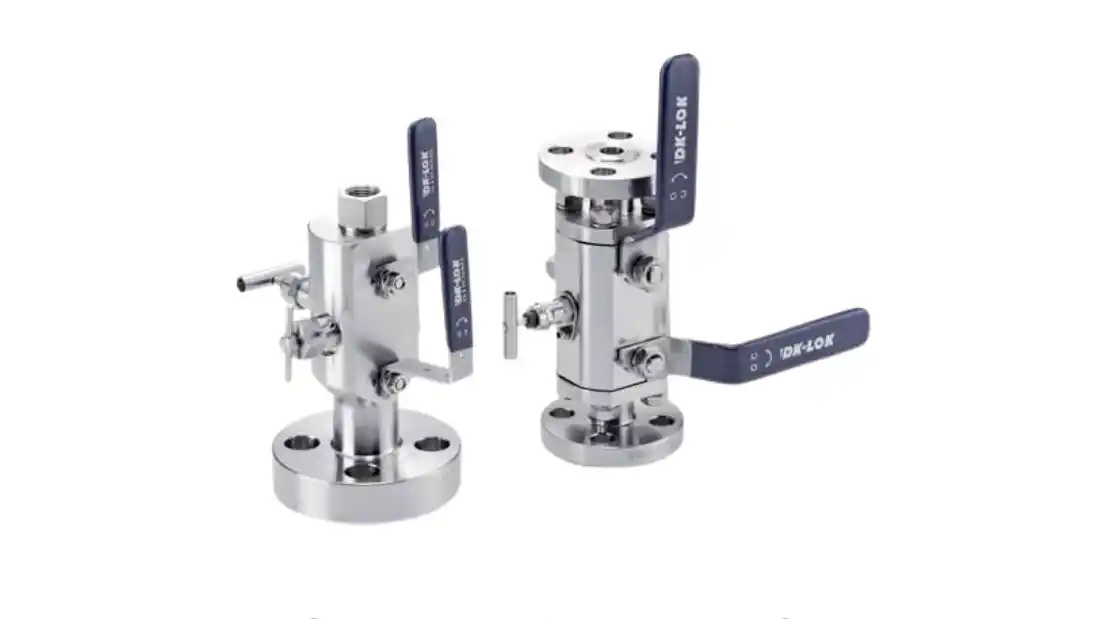
A DBB valve combines three functions in a single body:
- Primary isolation seat (block 1). First barrier between process and the maintenance area.
- Bleed port. A vent or drain between the two isolation seats. When the line is isolated, opening the bleed proves the isolation: any process leakage through block 1 is captured and depressurised at the bleed.
- Secondary isolation seat (block 2). Second independent barrier. Provides a defence-in-depth backup if block 1 leaks.
The defining feature is independence. Block 1 and block 2 are separate seats with separate stem actuators — they do not share a single mechanical failure point. A worn seat in block 1 does not compromise block 2.
The DOSH compliance argument
Under the OSH (Amendment) Act 2022, site management must demonstrate positive isolation before maintenance work proceeds on a critical line. The DBB configuration is the cleanest mechanical proof:
- Close block 1.
- Open the bleed.
- If the bleed flows, block 1 is leaking: close block 2 to back it up; re-test.
- If the bleed is dry, isolation is proven.
- Close the bleed.
- Issue the permit-to-work.
Compare this to a single-block valve, where seat leakage is undetectable without an external pressure test. The DBB makes the isolation status observable in real time, which is the audit defensibility that DOSH and most international auditors look for.
Where DBBs are required in Malaysian O&G
Three applications dominate.
1. Sample stations
Process sample take-off lines on hydrocarbon, sour, and chemical-injection service require positive isolation between the process and the sampling operator. DBB at the sample point is the documented industry practice.
2. Chemical injection points
Injection of corrosion inhibitor, scale inhibitor, demulsifier, or biocide into a process line creates a high-pressure path between the chemical-injection skid and the main process. DBB at the injection point isolates the skid from the process and provides a proven double-barrier when the skid is offline for maintenance.
3. Instrument hookups on critical service
Transmitter and gauge hookups on pressure-rated critical service may use DBB instrument-style valves. The two-seat configuration provides the auditor-defensible isolation that single-block instrument valves cannot.
In addition, DBB configurations are used at pipeline metering stations (block-and-bleed isolation of meter trains), flare-header tie-ins (proving isolation before hot work), and tank farm manifold isolation (proving isolation between tanks).
DBB valve types: integral vs modular vs valve-train
The DBB function can be implemented three ways. The mechanical configuration affects cost, weight, footprint, and the failure modes.
Integral DBB
A single valve body containing both isolation seats and the bleed port. Compact, lightweight, and lowest installation cost. Most common in instrument-service DBB valves and small-bore process applications.
Modular DBB
Two independent block valves bolted to a common manifold body, with the bleed integrated into the manifold. Heavier and longer than integral, but each block valve is independently removable for maintenance.
Valve-train DBB
Three discrete valves, block 1, bleed, block 2, installed in series with conventional pipe spools. Lowest part cost but highest installation cost (flanges, supports, footprint). Used in larger-bore process applications where the discrete valves are easier to source than a specialised DBB body.
For most Malaysian O&G instrument-service and small-bore process applications, integral DBB is the preferred configuration.
Material and pressure-rating selection
DBB valve material selection follows the same logic as any other valve on critical service:
| Service | Material baseline | Reference |
|---|---|---|
| General hydrocarbon | SS316/SS316L body, RPTFE seats | ASTM A276:2017 |
| Sour service (H₂S exposure) | SS316L per NACE; metal-seated | NACE MR0175:2021 |
| High-temperature steam | Carbon steel or SS316; metal-seated | ASME B16.34:2020 |
| High-chloride / aggressive | Monel, Hastelloy, Duplex | ASTM B564 / A789 |
Pressure-temperature rating must envelop the actual operating envelope at full operating temperature, not the room-temperature MAWP. End connections, flanged, butt-weld, socket-weld, threaded, or tube-fitting, must match the line standard exactly.
Common Malaysian O&G applications
Refinery sample stations
A refinery hydroprocessing unit may have 30+ sample take-off points across the catalyst bed, product separators, and gas-treatment trains. DBB at each point is standard practice — the operator depressurises the bleed, isolates upstream with block 1, opens the bleed to prove isolation, then opens block 2 to draw the sample.
Subsea umbilical chemical-injection
Subsea chemical-injection at platform topsides uses DBB at the injection tie-in. The skid-side DBB isolates the injection pump from the process line; the platform-side DBB isolates the platform piping.
Metering station block-and-bleed
A pipeline custody-transfer metering station includes a DBB at each meter train. During maintenance, the meter train is isolated by the DBB while adjacent trains remain in service. The bleed verifies isolation before the maintenance crew opens the meter.
Sourcing checklist
Before issuing the purchase order:
- Specify the configuration. Integral, modular, or valve-train. For instrument-service and small-bore, integral.
- Specify the connection standard. Match the line: flanged (ASME B16.5:2020), butt-weld (ASME B16.25:2017), tube-fitting, threaded.
- Specify the body material. Per the service-condition matrix above.
- Specify the seat material. RPTFE for general; metal-seated for high temperature or sour service.
- Specify the pressure-temperature rating. At actual operating temperature.
- Require API 6D:2021 documentation. Body pressure test, seat leakage test, fugitive emissions per ISO 15848-1:2015 for stem-sealing performance.
- Require MTR. Per valve, matching heat code.
- Verify chain of custody. Source through the authorised distributor: for DK-Lok DBB valves in Malaysia, that is Simlec Co Sdn Bhd, supplying direct customers and an authorised dealer network.
What goes wrong (and what to specify against it)
Three field-observed DBB failure modes are worth specifying against.
1. Block 1 seat erosion on sample service
Frequent sampling cycles wear the block 1 seat. The bleed becomes wet during isolation. Mitigation: specify metal-seated for high-cycle sample service; rotate the DBB inventory on a documented replacement schedule.
2. Bleed port plugging on inhibitor service
Chemical-injection DBB valves on viscous-inhibitor service can plug the bleed with inhibitor residue. Mitigation: specify a larger bleed orifice; install a heat-traced bleed line; include the bleed in routine maintenance checks.
3. Stem packing degradation on sour service
H₂S exposure degrades elastomer stem packings. Mitigation: specify graphite or PTFE-with-graphite stem packing per NACE MR0175:2021; specify fugitive-emissions performance per ISO 15848-1:2015.
Decision matrix at a glance
| Application | DBB configuration | Material baseline | Seat type |
|---|---|---|---|
| Refinery sample take-off | Integral | SS316L per NACE | Metal (high cycle) |
| Chemical injection tie-in | Integral or modular | Per service matrix | RPTFE or metal |
| Instrument hookup, critical service | Integral instrument-style | SS316L | RPTFE |
| Pipeline metering station | Modular or valve-train | Per service matrix | Metal |
| Flare-header tie-in | Modular | Carbon steel or SS316 | Metal |
| Tank farm manifold | Modular | SS316L | RPTFE |
Stakeholder note: the maintenance supervisor’s perspective
The DBB is the cheapest insurance the plant buys against a leaking-block-valve maintenance incident. The added capital cost over a single-block-plus-bleed configuration is recovered the first time a bleed flows wet on an isolation check, because that one observed leak is the difference between catching the seat-wear problem during a planned shutdown and discovering it during the maintenance work that was supposed to be safe.
Frequently asked questions
Is a DBB the same as a single-block valve with a downstream drain?
No. A DBB has two independent isolation seats with the bleed port between them. A single-block valve with downstream drain has only one isolation seat — the drain proves only that the downstream piping is depressurised, not that the seat is leak-tight.
Can I use a DBB on any service?
Yes, but the cost-benefit shifts. DBB is the standard configuration on critical service (sour, chemical-injection, sample, critical instrument hookups). On utility service (instrument air, low-pressure water), a single-block configuration is usually adequate.
What is the difference between DBB and DIB (double isolation and bleed)?
The terms are sometimes used interchangeably, but strictly: DBB means two independent block seats; DIB is the broader term that includes any double-isolation configuration. API 6D:2021 distinguishes between them and specifies the test protocols for each. The terminology overlap is itself a recurring debate on engineering forums — an Eng-Tips discussion on double-isolation-and-bleed vs double-block-and-bleed covers how the two terms get applied differently across vendor catalogues and project specifications, useful background when reviewing a vendor quote.
Do DK-Lok DBB valves include the bleed valve in the assembly?
Yes — the integral DBB valves Simlecco stocks include both block seats and the bleed port in a single body, with all three actuated independently.
1-Minute decision checklist
Need a DBB valve for a Malaysian project?
Simlecco stocks DK-Lok DBB valves, integral and modular configurations, in SS316L and NACE-compliant grades with full MTR, API 6D:2021, and ISO 15848-1:2015 documentation. Click the WhatsApp button on this page to discuss your specification, or fill in the contact form and we will respond within one business day.
Disclaimer: All brand names mentioned are trademarks of their respective holders.