- The 2 AM Call No Fitter Wants
- What Most Install Guides Get Wrong About the Ferrule Bite
- The Exact Installation Sequence
- Tube Preparation Rules
- Twin-Ferrule vs Single-Ferrule Under Vibration
- What Malaysian Plants Need to Know
- Frequently Asked Questions
- Can I reuse a ferrule that I only hand-tightened?
- What if the joint weeps during startup?
- Can I mix DK-Lok components with another brand's components?
- 1-Minute Decision Checklist (sizes 1/4″ to 1″)
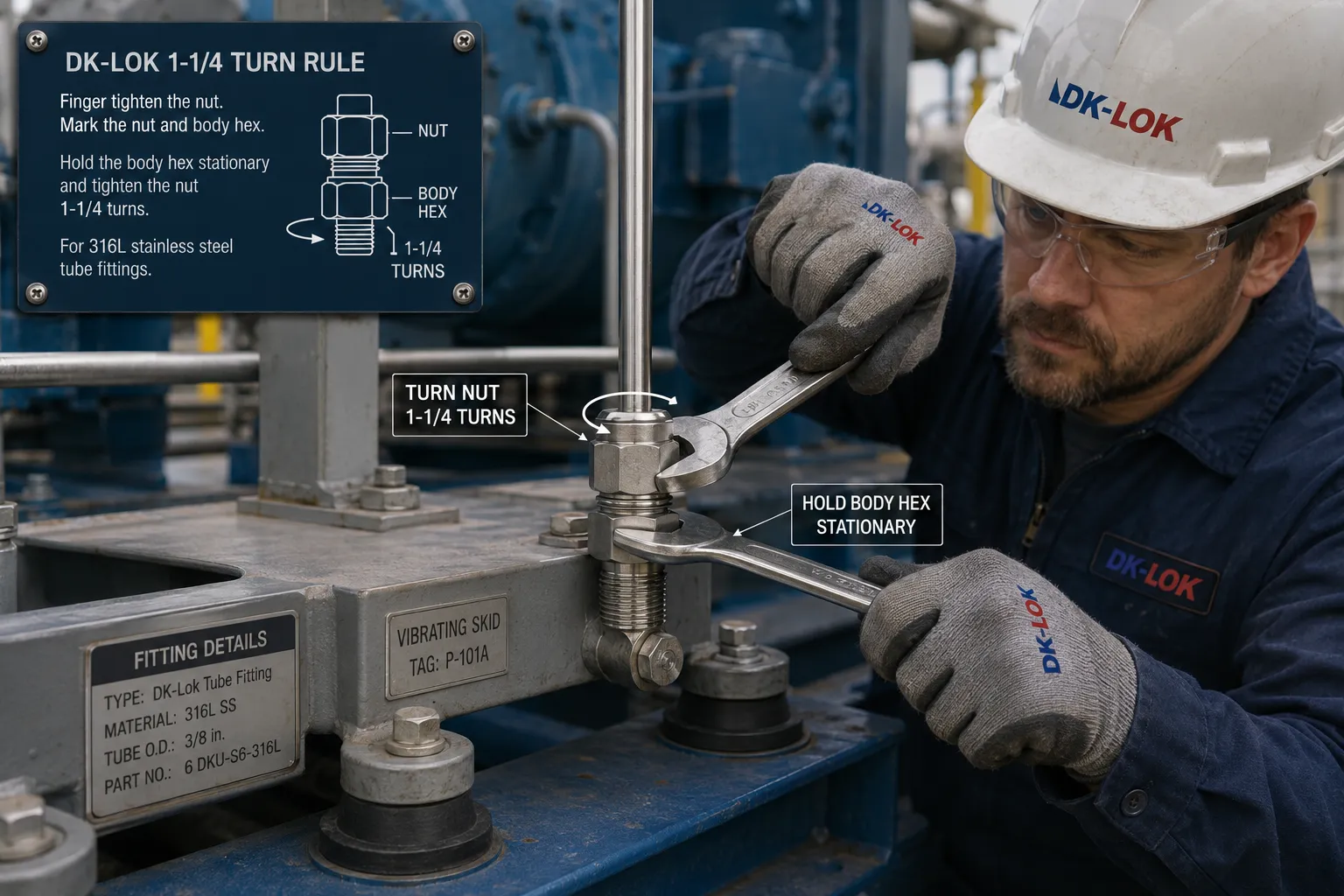
DK-Lok twin-ferrule fittings (1/4″–1″ sizes) install via exactly 1-1/4 turns of the nut past finger-tight, with the body held by a backup wrench. Smaller sizes (≤3/16″) use 3/4 turn. The rule is rotation count, not torque.
The 2 AM Call No Fitter Wants
A sharp, sustained hiss near a gas compressor skid, at a frequency just above the compressor’s normal noise floor, means an impulse line has just let go.
When a joint blows off a vibrating instrument bridge in a Kerteh processing unit at 2 AM, the root cause is rarely a defective fitting. The cause is almost always an installer who guessed the rotation count, skipped the backup wrench, or reused a previously-bitten ferrule.
For maintenance engineers, the pressure to get a unit back online before the next shift turnover leads to shortcuts. Hand-tightening “until it feels snug” guarantees a startup leak.
When the line vents on pressurisation, you face an emergency shutdown, ruined insulation, a thermography re-survey, and a hard conversation with the plant supervisor.
The integrity of your impulse lines depends entirely on tube preparation and rotation discipline. Get those right and twin-ferrule fittings hold for the design life of the system. Get either wrong and the joint fails the first time the compressor cycles.
Note for the Plant Manager:
While maintenance executes the work, the documentary burden of a blown impulse line in a regulated facility falls on the operator. Under the OSHA Amendment 2022 Expanded Principal Liability framework, DOSH audit findings can attach personal accountability to the signing manager. Standardising on traceable DK-Lok inventory with mill-certified heat codes per ASTM A213/A269-2023, and enforcing the documented 1-1/4 turn procedure across the maintenance team, creates the paper trail that demonstrates risk control during a DOSH audit.
What Most Install Guides Get Wrong About the Ferrule Bite
Most generic guides tell you to tighten the nut “until you feel strong resistance.” That advice causes more leaks than it prevents.
Resistance does not mean the ferrule has bitten — it often means the threads have started binding before the ferrule has fully engaged the tube surface.
A twin-ferrule fitting works by controlled mechanical deformation in two stages. The front ferrule advances along the body’s internal taper, creating a metal-to-metal primary seal. The back ferrule hinges inward and bites into the tube outer surface, providing mechanical grip against pull-out.
Both stages must complete or the joint will fail under vibration. Stop too early and the back ferrule never bites — the tube pulls out the moment the line pressurises.
From real failure-mode discussions on engineering forums: a recurring root cause in failed instrument-tubing joints is the installer failing to use a backup wrench on the body hex.
The tube twists along with the nut and either deforms into an oval (kills the primary seal) or rotates the ferrule against the tube surface instead of biting cleanly into it. Both failures pass a hydrotest and blow under thermal cycling.
The 1-1/4 turn rule is not vendor-specific marketing. Independent practitioner sources document the same rotation count:
- Plant & Works Engineering on twin-ferrule incorrect-tightening failure modes describes the bite-loss progression when the rotation count is shortened.
- The Los Alamos National Laboratory specification 15215 mandates 1-1/4 turns from finger-tight for tubing OD ≥ 1/4 inch as the engineering standard.
- Swagelok’s Installer’s Pocket Guide (MS-13-151) publishes the same rotation count for sizes 1/4″ through 1″.
Across vendors and across published specifications, the rule is the same. A skipped backup wrench or partial rotation count produces the field outcome regardless of which brand fitting is on the line: a weeping or blown joint on pressurisation.
The Exact Installation Sequence
To install a DK-Lok twin-ferrule fitting (1/4″ to 1″ sizes) without leaks, follow the mechanical sequence from the manufacturer’s installation manual. The procedure relies on counting, not feel:
- Bottom out the tube. Insert the tube into the fitting body until it bottoms firmly against the internal shoulder. If the tube doesn’t bottom out, the front ferrule has nothing to seal against.
- Finger-tighten the nut. Rotate the nut by hand until it stops. Do not use a wrench yet.
- Hold the body, rotate the nut. Hold the fitting body steady with a backup wrench on the body hex. Using a second wrench on the nut, rotate the nut exactly 1-1/4 turns past the finger-tight position. The DK-Lok installation manual specifies this rotation count for sizes 1/4″ through 1″.
Somewhere around the 1-turn mark, you’ll feel the wrench resistance step up sharply. That step-change is the back ferrule biting into the tube wall.
Push through it and complete the full 1-1/4 turns. Stopping at the resistance step leaves the bite incomplete.
For sizes 3/16″ and smaller, the specification is 3/4 turn past finger-tight, not 1-1/4. The smaller bore needs less rotation to complete both ferrule stages without crushing the tube wall.
If you skip the backup wrench, the tube twists with the nut. A twisted tube has either a deformed sealing face (front-ferrule seal fails) or a rotated ferrule that has dragged across the tube surface instead of biting cleanly (back-ferrule grip fails).
Either outcome is invisible from the outside and produces a joint that passes a hydrotest but fails under thermal cycling.
Tube Preparation Rules
The ferrule cannot bite into a damaged, scratched, or out-of-round tube surface. Before you touch the fitting hardware, the tube must be prepared correctly.
Cut the tube with a dedicated rotary tube cutter, not a hacksaw. A hacksaw leaves a jagged edge with burrs that score the front-ferrule sealing face.
After cutting, ream both the inner and outer diameter of the tube end to remove the burr ring left by the cutter.
Inspect the tube surface visually under good light before installing. If the tube outer diameter shows scoring, scratches, dents, or any deviation from round (commonly caused by storage on edge or by previous wrench grip), cut that section off and start with fresh tube.
The front ferrule requires a continuous, smooth, round sealing surface to form the primary metal-to-metal seal. Any defect in that surface creates a leak path the ferrule cannot bridge.
Tube wall thickness must match the working pressure of the system. Standard instrumentation tubing in 1/4″ size is typically 0.035″ or 0.049″ wall depending on pressure class.
Wall thickness below the rated minimum can collapse under ferrule compression, leaving the joint with no grip on a deformed tube end. Verify wall thickness against the manufacturer’s pressure rating chart before installing.
Twin-Ferrule vs Single-Ferrule Under Vibration
In high-vibration applications such as compressor skids, sour-gas booster stations, or steam-traced impulse lines, the mechanical design of the compression fitting directly affects how long the joint survives.
| Design | Vibration resistance | Field consequence under stress |
|---|---|---|
| Single-ferrule (generic category) | Limited | The single ferrule must perform both sealing and gripping simultaneously. Under continuous vibration, the seal and grip functions trade off (the joint either backs out under thermal cycling or fatigue-cracks at the ferrule bite.) |
| Twin-ferrule (DK-Lok design class) | Strong | The front ferrule handles the seal independently; the back ferrule handles the grip. The back ferrule’s geometry absorbs vibration kinetic energy before it transfers to the front-ferrule sealing surface. Separation of functions extends service life under continuous vibration. |
Twin-ferrule is the standard specification for instrument tubing in offshore, refining, and sour-gas service per the manufacturer’s documentation.
Different manufacturers’ twin-ferrule fittings are not designed to intermix — ferrule geometry, body cone angle, and tube-grip profile differ between brands. Brand substitution requires datasheet-to-datasheet verification, not standards-based interchange.
What Malaysian Plants Need to Know
Plants in Kerteh, Bintulu LNG, and Pengerang RAPID run sour gas (containing H₂S above NACE MR0175:2021’s 0.05 psia threshold for sour service classification) and high-pressure steam.
In these zones, generic compression fitting hardware fails rapidly to sulfide stress cracking, chloride pitting, or vibration fatigue.
We stock DK-Lok 316L twin-ferrule fittings in Malaysian warehouse for fast shipping to peninsular Malaysia. The manufacturer specifies these fittings to ASTM A213/A269-2023 with verifiable mill heat codes — the documentation level DOSH expects for pressure equipment certification.
For sour service applications above NACE MR0175:2021’s threshold, never mix brands or substitute components without full system re-qualification — component-level certification is not sufficient.
We carry NACE-stock in 316L for these applications; non-stocked grades typically have 12–16 week lead times from the manufacturer.
Why Traceability Matters in Malaysian O&G:
A compression fitting without a heat code is impossible to certify under DOSH pressure equipment audit. We provide mill test reports with every DK-Lok shipment so your facility’s compliance documentation chain is intact when an audit happens. Per DOSH Malaysia and the OSHA Amendment 2022 Expanded Principal Liability framework, demonstrated traceability is what separates an audit finding from a prosecution.
Frequently Asked Questions
Can I reuse a ferrule that I only hand-tightened?
No. The moment any rotation past finger-tight begins, the back ferrule has started its inward bite into the tube surface — even if the bite isn’t complete.
A partially-bitten ferrule will not seat correctly on a new tube. Always use a new ferrule on each fresh installation.
The fitting body and nut can be reused (within the manufacturer’s specified re-makeup count, typically 5–10 cycles); the ferrules are one-time-use.
What if the joint weeps during startup?
If a weep appears at first pressurisation, depressurise the line immediately. Verify the tube was fully bottomed before re-attempting.
You can advance the nut by 1/8 of a turn maximum to attempt a re-seat, but if the leak persists, do not keep tightening. The ferrule bite has failed, the tube surface was scratched, or the assembly was contaminated.
Cut the tube back 1″, reprepare the new end (cutter + ream + inspection), and install with fresh ferrules.
Can I mix DK-Lok components with another brand’s components?
DK-Lok MP-series fittings follow DK-Lok’s own dimensional spec. Cross-brand substitution (e.g. with Swagelok MP) is not certified by ISO 8434-1:2007, which covers 24°-cone metric tube fittings rather than 60°-cone MP-series.
Treat any cross-brand interchange as a datasheet-to-datasheet verification exercise — not a standards-based equivalence.
For sour service specifically, per NACE MR0175:2021, mixed-brand systems require full re-certification of the entire pressure boundary, not just the individual mixed components.
1-Minute Decision Checklist (sizes 1/4″ to 1″)
- Cut tube with rotary tube cutter (never hacksaw); ream inner + outer diameter
- Visually inspect tube surface: cut off and restart if scratched, scored, or out-of-round
- Verify tube wall thickness matches system pressure rating
- Insert tube into fitting body until it bottoms firmly against the internal shoulder
- Finger-tighten the nut until it stops
- Mark the nut at finger-tight position to track rotation
- Hold the body with a backup wrench on the body hex
- Using a second wrench on the nut, rotate exactly 1-1/4 turns past finger-tight (or 3/4 turn for sizes ≤3/16″)
- Pressurise to operating pressure; check for weep
- If weep appears, depressurise and follow the FAQ triage: do not keep tightening
Need help sourcing twin-ferrule fittings for your next shutdown?
Click the WhatsApp button on this page to speak with our technical team directly, or fill in the contact form and we will respond within one business day.
Disclaimer: All brand names mentioned are trademarks of their respective holders.