- How Tube Fittings Procurement Works in Malaysia
- The Hidden Liability of Mixed-Brand Assemblies
- The Procurement Case for Vendor Consolidation
- Material Lead Times: Don't Get "Turnaround Trapped"
- TCO Matrix: Material Procurement
- The Single-Brand Strategy: Why Traceability Wins
- Frequently Asked Questions
- 1-Minute Decision Checklist
Specifying generic materials for high-pressure systems creates hidden liabilities. From mixed-brand assembly blowouts to DOSH audit nightmares, a single-brand procurement strategy can simplify component compatibility and traceability checks.
How Tube Fittings Procurement Works in Malaysia
A defensible procurement cycle moves through five stages. Specification capture pins down material grade, pressure-temperature class, end connection and certification scope. Vendor selection filters for authorised distribution and in-country stock. MTR review confirms heat code, mill source and chemistry before goods inwards. Receipt verification cross-checks the stamped heat code on the body against the paperwork. Installation handover packages the MTR set with the as-built drawings for DOSH audit defence.
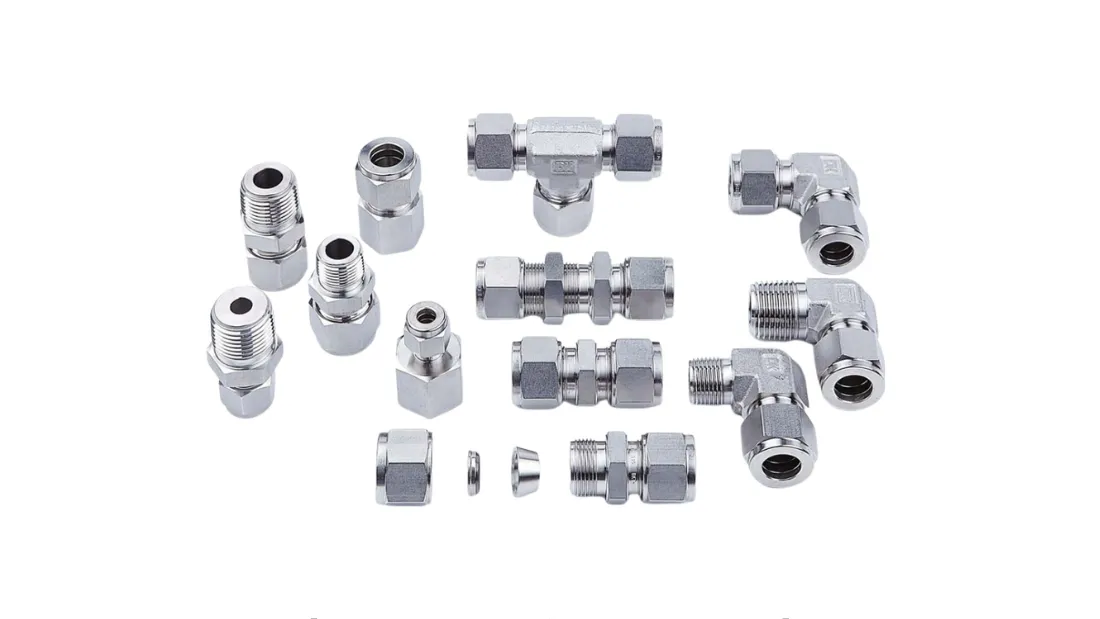
A typical Malaysian requisition mixes three fitting families. Twin-ferrule compression fittings dominate small-bore instrumentation and impulse lines for their installer-friendly assembly. Weld and buttweld fittings carry the larger process connections where vibration or fugitive emission rules forbid mechanical joints. Threaded fittings still appear on low-pressure utility runs, though most onshore O&G specs now restrict them above DN15.
SS316L tubing is commonly specified for coastal and offshore service; ASTM A269/A269M-25 covers tubing requirements, not site-specific alloy selection. Aggressive duties step up to Monel 400 (chlorides, hydrofluoric acid) or Hastelloy C-276 (sour gas, mixed acid). Small-bore instrumentation tubing includes 6 mm and 1/4 inch OD sizes; larger process piping connections start at DN15 and run through DN50 for typical skid work. The right family on the requisition depends on the service line class, not the installer’s preference.
The Malaysian supply landscape splits into two camps. Authorised distributors (Simlecco for DK-Lok is an example) hold local stock with documented chain of custody from the mill. General hardware importers carry parts that fit geometrically but rarely arrive with usable MTRs. Lead times reflect the split: in-country stock ships in days, direct import runs 12 to 16 weeks. Published estimates indicate DOSH audits flag missing heat codes and broken MTR chains as the most common documentation findings on instrument racks. The vendor consolidation argument below works from that baseline.
The Hidden Liability of Mixed-Brand Assemblies
OSHA 1994 section 15 requires employers to provide and maintain safe plant, so far as is practicable. In industry forums like Reddit’s r/OilandGas, veteran technicians frequently warn against mixed-brand assemblies, the practice of pairing a nut from one brand with a body from another.
While they may “fit” geometrically, the ferrule geometry, body cone angle, and tube-grip profile can differ between brands. An unqualified combination can compromise grip under vibration or pressure. In documented field failures, a mixed-brand connection on a compressor skid can hold for months before “spitting” the tube during a sudden pressure spike. A failure can lead to production losses and, where a statutory duty is breached, penalties under OSHA 1994 as amended in 2022. Buying instrumentation tube fittings based purely on the lowest unit price from a general hardware catalog introduces material financial exposure.
The Procurement Case for Vendor Consolidation
A typical industrial plant in Kerteh or Pasir Gudang requires thousands of connections. Procurement professionals often waste hundreds of hours splitting purchase orders across different hardware shops. This introduces supply chain bloat and cross-brand liability.
The Uncatalogued Stock Problem: On maintenance forums, a common complaint is uncatalogued stock, where parts are ordered but arrive without documentation, rendering them useless for a DOSH-audited system. A reliable industrial supplier provides a single-source ecosystem. By standardizing, you source every connector, ball valve, flange, and tube clamp from a single audited source.
Whether your requisition calls for steel pipe routing, forged fittings, thread fittings, or heavy-duty buttweld fittings, a unified approach ensures that a hydraulic hose and its matching hose fitting actually meet the required pressure rating without dangerous trial and error.
Material Lead Times: Don’t Get “Turnaround Trapped”
The material you specify dictates your supply chain risk.
- SS316 Stainless Steel: The standard for Malaysian semiconductor cleanrooms and offshore skids. Tubing must comply with the specified material standard, such as ASTM A269/A269M-25.
- The Hardness Trap: A frequent real-world failure occurs when procurement sources stainless steel tubing that is too hard (above the manufacturer’s recommended hardness; DK-Lok recommends HRB 80 or below for stainless steel tubing). If the tube is harder than the ferrule, the ferrule cannot “bite” into the metal. It looks fine during installation, but leads to immediate blowouts during commissioning.
- Exotic Alloys (Monel/Inconel): For some sour-gas duties, these may be required; select materials against the actual service conditions. However, relying on an overseas manufacturer often leads to 12–16 week delays. Localized inventory in Malaysia is the only hedge against these “turnaround traps.”
TCO Matrix: Material Procurement
| Material Grade | Initial Cost | Lead Time Risk (MY) | Real-World “Gotcha” |
| Carbon Steel / Brass | Low | Low | Corrosion in humid Malaysian coastal climates. |
| SS316 Stainless Steel | Moderate | Medium | Counterfeit “316” that is actually 304 (always use a PMI test). |
| Monel / Exotics | High | Extremely High | 3-month lead times if not stocked locally by a specialized distributor. |
The Single-Brand Strategy: Why Traceability Wins
Simlecco supplies DK-Lok tube fittings and valves. In the O&G world, hardware without a heat code carries no traceability link to its certifying mill.
Industry experts frequently cite cases where refineries have faced retroactive documentation audits from DOSH (JKKP). Missing traceability can prompt investigation; a prohibition notice under section 48(2) requires likely immediate danger to life or property. The procurement team is then forced to hunt down MTRs (Material Test Reports) for hundreds of individual points retroactively, a logistical problem that could be avoided with a single-brand, traceable procurement strategy.
Frequently Asked Questions
Can we mix DK-Lok with other brands to save money?
Do not assume interchangeability. DK-Lok documents qualified intermix combinations with defined conditions and warranty coverage. Confirm the exact combination, service limits and written warranty terms before substitution.
Why is an MTR (Material Test Report) non-negotiable?
An MTR is your documentary defence. It proves the metal isn’t from an uncertified mill. In high-pressure environments, the wrong carbon content can lead to stress corrosion cracking (SCC) in months, not years.
When should procurement choose buttweld instead of compression?
Compression fittings are the standard for maintenance speed. However, for lines subject to extreme, violent vibration (like near large reciprocating pumps), engineers may specify buttweld fittings, but the welded joint and its supports still require assessment for vibration-induced fatigue.
1-Minute Decision Checklist
- Check the Req: Does it call for standard SS316 or an exotic alloy like Monel?
- Paperwork First: Demand a certified Material Test Report (MTR) before issuing the PO.
- Physical Verify: Ensure the heat code stamped on the nut/body matches the MTR exactly.
- Local Stock: Can the supplier deliver today, or is there a 12-week wait?
- Audit Defense: Stick to one brand to simplify your paper trail for Malaysian regulatory audits.
Need help sourcing traceable, exact-spec tube fittings?
Click the WhatsApp button on this page to speak with our technical procurement team, or fill in the contact form and we will get back to you within one business day.
Disclaimer: All brand names mentioned are trademarks of their respective holders.