- The 5-Step O&G Procurement Workflow
- Step 1: Specification capture
- Step 2: Vendor down-select
- Step 3: Quote review
- Step 4: Receipt verification
- Step 5: Installation handover
- O&G-Specific Service Considerations
- Sour service (H₂S present)
- High-pressure service
- Offshore service
- Sourcing Checklist
- Comparison: Authorised Distributor vs Generic Importer
- DOSH and Principal Liability
- FAQ
- Can twin-ferrule fittings from different brands be mixed?
- What is the lead time for non-stock items?
- Why is the heat code so important?
- Order from Simlecco
Sourcing O&G instrumentation fittings in Malaysia is not the same exercise as buying generic tube fittings off a hardware shelf. Impulse lines, sample stations, and transmitter hookups in Pengerang, Kerteh, and Bintulu have to survive sour-service chemistry, compressor vibration, and DOSH audit. This article gives a 5-step procurement workflow specific to O&G hookup work, with the standards and certificates you should require at each step.
The 5-Step O&G Procurement Workflow
Each step has a deliverable that goes into the project file. If a step has no document attached, the audit trail breaks at that point. Plan the workflow around the deliverables, not the order numbers.
Step 1: Specification capture
Before any RFQ, lock down the service-specific parameters that drive the fitting choice. Missing any one of these forces the vendor to assume, which puts the audit trail back on you.
- Service medium and phase (sour gas, condensate, instrument air, sample fluid)
- Design pressure and design temperature with derating point
- Sour service flag with H₂S concentration if applicable
- Tubing OD and wall thickness (e.g. 1/2″ x 0.049″ 316L)
- End connections (NPT, ISO 8434-1:2007 24°-cone, flange class)
Step 2: Vendor down-select
For brands named on the project specification, the only valid source is the manufacturer’s authorised distributor for Malaysia. Cross-check the authorisation letter — counterfeit fittings are not theoretical; they appear in O&G supply chains and they fail under vibration.
Simlecco holds the DK-Lok distribution authorisation for Malaysia. For any branded line item, ask the vendor for a copy of the current authorisation letter from the OEM. If they cannot produce it on request, they are not the authorised channel.
Step 3: Quote review
Review the quote against three documentary checks. Each one is a single line in the comparison sheet but the project hinges on all three being right.
- Standard editions cited: NACE MR0175:2021, API 598:2023, ISO 8434-1:2007. Older editions are not equivalent.
- Mill Test Report (MTR) per shipment to EN 10204:2004 type 3.1, with heat code traceability to the body and nut.
- Lead time committed in writing against the project schedule, with stock position confirmed by the distributor.
Step 4: Receipt verification
On receipt, verify before stores release. PMI (Positive Material Identification) the body of a sample from each heat for critical service. Confirm the heat code stamped on the part matches the MTR. Require a certificate of conformance per batch, signed and dated.
If the heat code on the part is unreadable or absent, reject the batch. A part without traceability cannot be defended in a DOSH investigation, regardless of who supplied it.
Step 5: Installation handover
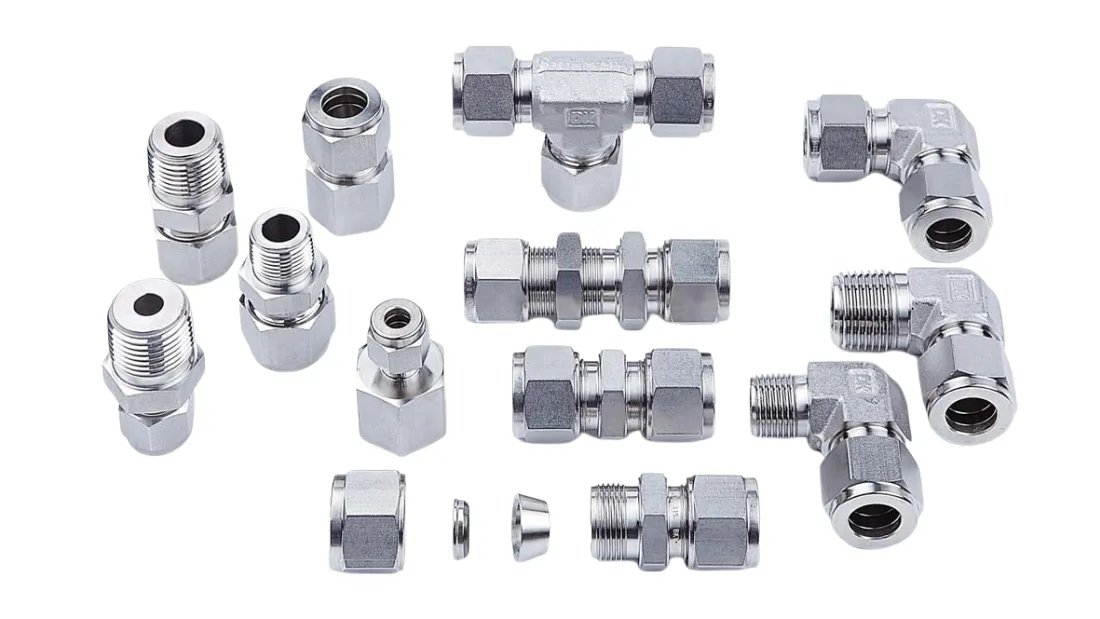
Installation discipline finishes the procurement chain. Twin-ferrule fittings are made up per the manufacturer’s rotation count rule — typically 1-1/4 turns past finger-tight for the first makeup. Cross-brand mixing voids the joint integrity.
Commissioning leak test follows API 598:2023 where applicable. The completed documentation file, MTR, COC, PMI report, leak test record, goes against the asset tag in the CMMS. That file is what defends the operator at the next audit.
O&G-Specific Service Considerations
Sour service (H₂S present)
NACE MR0175:2021 sets hardness limits to prevent sulphide stress cracking. Typical for 316 fittings is HRB 80-90 in the as-supplied condition. The hardness number must appear on the MTR or in a supplementary cert from the supplier. Cold-worked parts not re-tested for hardness do not qualify.
High-pressure service
Standard instrumentation tube fittings are rated to 6,000 psig. HP-series fittings (e.g. DK-Lok HP series) extend the rating up to 60,000 psig. The body material, end connection geometry, and tube wall all change above 6,000 psig — don’t substitute standard parts into an HP application.
Offshore service
Chloride exposure and salt spray drive material selection above the 316L default. For the most aggressive offshore locations, splash zone, exposed deck, specify 6Mo (UNS S31254) or duplex 2205 instead of 316L. The fitting body alloy must match the tubing alloy; mixing 316L body with 6Mo tube creates a galvanic cell at the ferrule grip.
Sourcing Checklist
- Service medium, design pressure, design temperature, and sour-service flag captured on the requisition.
- Vendor is the authorised distributor for any branded line items; authorisation letter on file.
- Quote cites NACE MR0175:2021, API 598:2023, ISO 8434-1:2007 by edition.
- EN 10204:2004 type 3.1 MTR committed per heat, with heat code stamping on parts.
- PMI plan defined for critical-service receipt; reject path for unreadable heat codes documented.
- Installation procedure references the manufacturer rotation count rule; no cross-brand mixing.
- Commissioning leak test result and full documentation file filed against the asset.
Comparison: Authorised Distributor vs Generic Importer
| Item | Authorised distributor | Generic importer |
| OEM authorisation letter | Current, on request | Not available |
| EN 10204:2004 type 3.1 MTR | Per heat, traceable to part | Often missing or generic |
| NACE MR0175:2021 hardness data | On the MTR | Rarely documented |
| Lead time on standard stock | Local stock, days | Import, 12-16 weeks |
| DOSH audit defensibility | Full paper trail | Trail breaks at receipt |
DOSH and Principal Liability
Under the OSH (Amendment) Act 2022, the principal carries liability for documented control of safety-critical components. DOSH Malaysia investigators reading the documentation file after an incident will look for the heat code linkage between part and MTR, the NACE compliance evidence for sour service, and the installation record. Confirm current penalty schedules with DOSH Malaysia directly.
FAQ
Can twin-ferrule fittings from different brands be mixed?
No. Ferrule geometry, body cone angle, and tube grip profile differ between brands. ISO 8434-1:2007 governs the 24°-cone metric tube fitting standard, not cross-brand interchange of MP-series or twin-ferrule designs. Re-validate the full assembly under NACE MR0175:2021 before any mixed assembly enters sour service.
What is the lead time for non-stock items?
Industry benchmarks suggest specialty high-alloy fittings (6Mo, duplex, HP-series) typically import in 12-16 weeks when not held by an authorised distributor. Holding local stock at the distributor is the only way to compress that to project-feasible lead times.
Why is the heat code so important?
The heat code is the single data point that ties the physical part back to the mill certificate. Without it, the MTR cannot be matched to the installed component, and the audit trail breaks. For sour service, no heat code means no NACE MR0175:2021 evidence.
Order from Simlecco
As the authorised DK-Lok distributor for Malaysia, Simlecco holds instrumentation tube fittings, valves, and HP-series fittings in stock with full EN 10204:2004 type 3.1 certification. For sour-service or offshore-specific requirements, contact our technical team with the five Step 1 parameters and we will return a quote with standards, lead time, and certificate scope confirmed.