The A-to-F letters are trade nomenclature. Neither governing standard uses them: A-A-59326 classifies by Roman numeral, and EN 14420-7 uses two-letter connection codes. They map to each other by configuration, and EN 14420-7 publishes a designation format you can put on a purchase order. Get the configuration right first, then write the order in the standard’s own language.
What the letter encodes
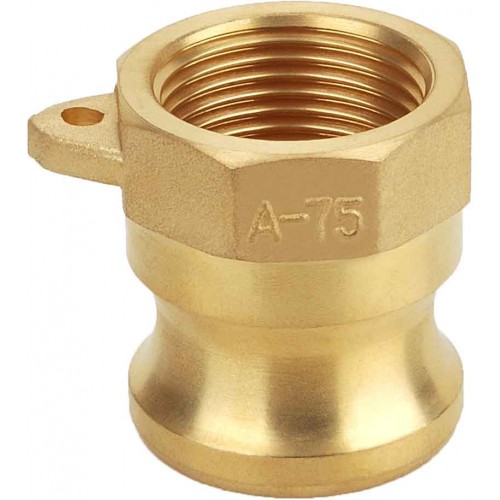
The letter describes the coupling’s back end. The mating interface is common across the family: a grooved adapter, a female coupler, and two cam arms drawing it against a gasket. What differs is what the half connects to behind it: a hose tail, a male thread, or a female thread. The letter carries that, along with whether the half is male or female, which is why two halves can share a letter and still not go together.
Two things follow that matter more than memorising the alphabet.
The letters do not pair off—no A-to-B or C-to-D logic. Male adapters mate with female couplers of the same size and standard, whatever letters they carry, and you choose each half independently by its back end. The letter tells you nothing about dimensional compatibility, which you still have to verify.
And the letter alone will not buy you anything. It carries nothing about the standard, the material, the gasket, the pressure or the thread form.
The cross-reference
| Trade letter | Configuration | US type (A-A-59326) | EN 14420-7 code |
|---|---|---|---|
| A | Male adapter, internal thread | I | AF |
| B | Female coupler, external thread | VII | BF |
| C | Female coupler, hose tail | VI | CC |
| D | Female coupler, internal thread | V | DF |
| E | Male adapter, hose tail | II | EC |
| F | Male adapter, external thread | III | FF |
This maps configuration only. It is not a statement of dimensional equivalence or of conformity between the two standards, and it does not license mixing halves across them. For an actual order, verify the applicable specification sheet revision on the US side, and the manufacturer’s declared conformity on the EN side.
Writing the order in the standard’s own language
EN 14420-7 gives a worked designation format, and it is the cleanest thing a buyer can put on a line item:
Coupler EN 14420-7 – 20 – DF – CW614N
Standard, nominal size, connection code, material. Each element points to a defined clause, so the supplier has nothing left to interpret. “2-inch Type C” leaves most of it open.
Standards also specify threads, and this is where mixed-standard orders quietly go wrong. EN 14420-7 Table 2 specifies internal threads to EN ISO 228-1 (G), sealing on a face, and external threads to EN 10226-1 (R). So a line that asks for EN 14420-7 conformity and an NPT back end is asking for two incompatible things, and the supplier will resolve that silently unless you catch it.
A complete line still needs what the designation cannot carry: the manufacturer and part number, the gasket compound by the manufacturer’s own designation, the hose attachment where a tail is involved, and the service conditions. Treat the designation as the specification and the rest as the RFQ package.
What EN 14420-7 covers, and where it stops
EN 14420-7:2022 specifies the design, materials, dimensions, and marking for cam locking couplings carrying liquids, solids, and gases. It excludes liquefied gas and steam. Cam arms must be operable by hand without tools. The current reference includes the corrigendum EN 14420-7:2022/AC:2023, which corrects a torque unit in Table 8.
If your line carries steam or liquefied gas, this is the wrong product family, and no gasket choice will make it correct.
The pressure envelope needs care, because the documents disagree. EN 14420-7:2022 gives cast-aluminium couplings in all sizes, and all DN 100 couplings, a range of −0.8 to 10 bar; other couplings are printed as 0.8 to 16 bar, with no minus sign. But EN 14420-1:2013 clause 4.3 gives −0.8 to 16 bar with the same cast-aluminium exception.
That positive lower limit in the second row is what the English text of EN 14420-7 prints. Whether that is intended to exclude vacuum service for those couplings, or is an artefact of the drafting, a summary can’t settle. If the duty involves suction or vacuum, get the manufacturer’s written confirmation for the specific coupling rather than relying on either published range. The standard temperature range runs −20 to +65 °C, which is the figure most likely to be exceeded on an outdoor line in full sun.
Material and size sub-limits sit inside those bands. Confirm the rating against the actual size, material and manufacturer before the figure goes anywhere near a datasheet.
Material and gasket
Aluminium is the volume default. Stainless, usually 316, is specified where corrosion, washdown, food or marine exposure govern. Brass and bronze appear in seawater and spark-sensitive duty. Polypropylene and nylon cover chemically aggressive service at low pressure, where weight savings also matter.
None of that is a compatibility statement. “Fuels”, “chemicals” and “coastal” are categories rather than specifications. What decides is the alloy, the medium and its concentration, temperature, chloride exposure, galvanic contact and the cleaning chemistry. Ask the manufacturer for its position on your specific medium, and keep the answer with the requisition.
The gasket is the wetted seal and carries its own service envelope. Buna-N, PTFE, EPDM and FKM are families rather than single materials, and “Viton” alone covers several FKM formulations. Specify the manufacturer’s compound designation. A correct 316 body with an unsuitable gasket still fails.
For a hose end, the coupling is only part of the specification. EN 14420-1 covers the tail, securing collar, and clamp arrangement, and the hose, gasket, and coupling limit the assembly rating.
Locking is an orderable feature.
Cam arms are held by their own geometry, which is worth engineering on any line carrying hazardous or heated media.
A-A-59326 distinguishes styles, and a positive self-locking arrangement for the cam arms is available as a defined style you can order. Revision D records that distinction; confirm the wording and style identifiers against the current Revision E sheet for the item you are buying. Ask the manufacturer which locking option applies to the specific coupling.
Depressurise before breaking any coupling, whatever the locking arrangement.
Standards status for the PO
A-A-59326 is current at Revision E. A validation notice dated 27 May 2026 confirms it remains active. Such a notice confirms the revision still stands, so cite Revision E itself.
EN 14420-7:2022, with AC:2023, is the current European reference. DIN 2828 is withdrawn and superseded by DIN EN 14420-7. A supplier quoting DIN 2828 is quoting a withdrawn document, which is legitimate only as an explicitly identified legacy contractual reference, never as current conformity.
Comparing quotations
Ask each supplier for the standard, the edition including any corrigendum, the connection designation in that standard’s own terms, and their part number. Compare those four fields across quotations.
Suppose two quotations cite different standards; that alone does not prove different physical products, because it may reflect different documentation scope or simply a quotation error. Ask for the conformity evidence and compare the actual configuration and ratings before drawing a conclusion from price.
Sources: EN 14420-7:2022, Table 2 and clause 7 · EN 14420-1:2013, clause 4.3 · EN 14420-7:2022/AC:2023 · A-A-59326 record, DLA · DIN 2828 withdrawal record