- Quick Solutions Index — Symptom, Fast Fix, When to Escalate
- Why Low Pressure Is a System Question First
- Pump-First Diagnostic: The Five-Step Sequence
- 1. Confirm pump output with an isolated gauge test
- 2. Verify the relief valve setting
- 3. Check reservoir level and breather
- 4. Inspect return-side filter restriction
- 5. Inspect hoses for damage
- Hose-Specific Failure Modes
- Decision Checklist Before You Order Replacement Hose
- When to Stop and Call Your Senior Engineer
- FAQ
- Can I just tighten the fittings to restore pressure?
- My new hose is the right size but pressure is still low. Why?
- How often should hydraulic hoses be inspected?
- Does Malaysian humidity affect hydraulic hose life?
- Source Your Replacement Hose and Fittings from Simlecco
Low pressure in a hydraulic circuit is almost always a system symptom, not a hose property. Before you touch a hose, work the diagnostic from the pump outward: confirm pump output on an isolated gauge, verify the relief valve setting against the system design, check reservoir level and breather condition, and inspect the return-side filter for restriction. Only after those checks rule out a system cause do hose-specific failures (cover damage, tube delamination, fitting slippage) become the likely culprit.
This guide is written for procurement and maintenance engineers at Malaysian O&G and process plants who need a defensible diagnostic sequence aligned with SAE J517:2021, ISO 18752:2019 and the safety requirements of ISO 4413. DK-Lok instrumentation fittings and a range of industrial hoses suited to Malaysian service conditions are held in Simlecco’s Selangor stock.
Safety warning. Never tighten fittings on a live, pressurised hydraulic circuit. Depressurise to atmospheric, lock out the prime mover and bleed stored energy from accumulators before any inspection or torque adjustment. Hydraulic fluid injection injury at high pressure can be life-threatening and requires immediate surgical attention; ISO 4413 and DOSH Malaysia guidance under the OSH (Amendment) Act 2022 both treat it as a critical hazard.
Quick Solutions Index — Symptom, Fast Fix, When to Escalate
If you have isolated the symptom, here is the fast-fix path. If the symptom does not match or the fast fix does not resolve it, work through the full diagnostic sequence below.
| Symptom | Likely Cause | Fast Fix | Escalate If |
|---|---|---|---|
| Sudden pressure drop on a previously stable circuit | Open relief valve, blown hose, dropped fitting | Isolate the line; pressurise downstream of the suspected leak; replace the damaged component | Drop persists after replacement |
| Pressure low at startup, climbs slowly | Reservoir level low, suction air ingress, viscous fluid | Top up the reservoir; check suction-side fittings for tightness; run a warm-up cycle | Cavitation noise from pump |
| Pressure cycles between high and low | Worn relief valve, leaking accumulator, sticking pilot | Inspect the relief valve setting; replace the accumulator pre-charge | Repeats after rebuild |
| Pressure correct at gauge but low at actuator | Restriction in line, kinked hose, partially closed valve | Inspect routing; replace the kinked section; verify valve positions | No restriction found |
| Pressure intermittent or dropping under load | Internal pump wear, cracked porting, control valve worn | Schedule a pump assessment; replace the seal kit | Pump output below datasheet |
The 5-step diagnostic below walks through each fast fix in depth — when to do it, what to verify, what to escalate.
Why Low Pressure Is a System Question First
A hose is a passive conduit. It cannot generate pressure, lose pressure independently or create flow on its own. When a gauge reads low, the energy budget of the system has shifted somewhere upstream or downstream of the hose.
Replacing hoses before ruling out the pump, relief valve, reservoir and return path is the most common reason a “fixed” system fails again the same week. The five-step sequence below is the order most OEM service manuals recommend for fault isolation.
Pump-First Diagnostic: The Five-Step Sequence
1. Confirm pump output with an isolated gauge test
Install a calibrated gauge directly at the pump outlet and load the circuit through a throttling valve. If the pump cannot reach its rated discharge pressure on isolation, the fault is upstream of the hoses.
Worn vane or piston elements, shaft seal failure and excessive case drain flow all show up here. Compare measured pressure rise against the OEM datasheet at the same shaft speed and fluid temperature, since both shift the working curve.
2. Verify the relief valve setting
A relief valve that has drifted, been re-set by a previous shift or is stuck partly open will cap system pressure well below design. Cross-check the actual cracking pressure against the hydraulic schematic, not against memory.
If the valve is dumping fluid back to tank prematurely, reservoir temperature will climb. Treat any unexplained rise above 60 C as a diagnostic clue, not a normal operating condition.
3. Check reservoir level and breather
Low fluid level starves the pump and pulls air into the suction line. A blocked or saturated breather creates a partial vacuum in the reservoir that produces the same effect.
If you suspect suction-side starvation or cavitation, see our companion article on hydraulic suction problems and NPSH before continuing the rest of the sequence.
4. Inspect return-side filter restriction
A clogged return filter raises backpressure on actuators and reduces useful pressure differential at the tool. Read the filter differential indicator under load, not at rest.
Replace the element if the indicator is in the bypass band. Sample the fluid for ISO 4406 cleanliness if the same element clogs repeatedly, since the root cause is upstream contamination.
5. Inspect hoses for damage
Only after steps 1 through 4 are clean should you inspect hoses for swelling, cover blistering, external leakage or fitting movement. A visibly good hose on a sick system is not your problem.
Walk each line end to end. Check routing against minimum bend radius, contact with sharp edges and clearance from heat sources. Note any witness marks at the ferrule that suggest the hose has shifted on the fitting.
Hose-Specific Failure Modes
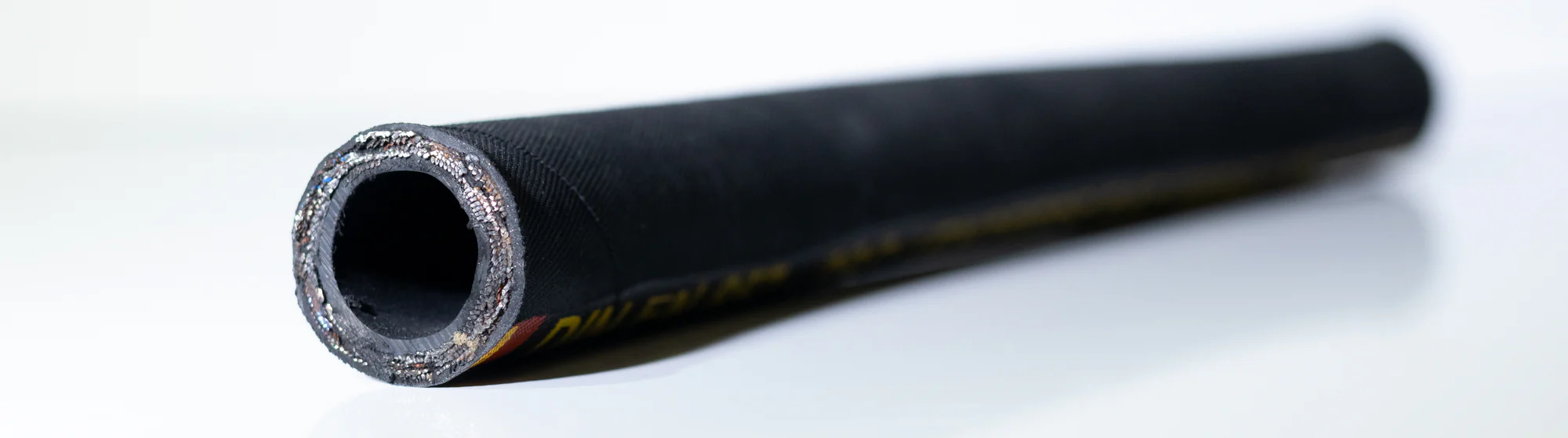
When the system checks point to a hose, the failure mode dictates the action. SAE J517:2021 and ISO 18752:2019 are the controlling specifications for hydraulic hose construction and rating, and both require the assembly be replaced rather than repaired in most failure cases.
| Failure mode | Observation | Action |
|---|---|---|
| Cover damage exposing wire braid | Cuts, abrasion or UV cracking with reinforcement visible | Replace the assembly. A compromised cover allows corrosion of the braid and the rated burst pressure no longer applies. |
| Tube delamination | Soft spots, blistering, or rubber particles in the returned fluid | Replace the assembly. Often indicates fluid incompatibility or a temperature excursion. |
| End fitting slippage | Witness marks on the hose at the ferrule, weeping at the crimp | Cut back, replace the fitting on fresh hose. Never re-crimp the same end. |
| Permeation weep | Damp cover with no visible leak source | Acceptable in small amounts on specific constructions. Replace if it stains a noticeable area within 24 hours. |
| Kink set | Permanent bend below minimum bend radius | Replace. The reinforcement is already damaged even if the hose looks intact. |
Decision Checklist Before You Order Replacement Hose
- Pump isolation gauge test completed and within OEM tolerance.
- Relief valve setting verified against the latest hydraulic schematic.
- Reservoir level above pump centreline; breather clear; fluid at operating temperature.
- Return filter differential within the green band under load.
- Replacement hose matches original construction (R-grade per SAE J517:2021) or equivalent ISO 18752:2019 performance class.
- Working pressure of the replacement exceeds maximum system pressure with a 4:1 safety factor on burst.
- End fittings ordered from the same brand and series as the new hose. Never mix crimp brands on the same assembly.
- Fluid type, temperature range and ambient exposure confirmed against the hose manufacturer compatibility chart.
When to Stop and Call Your Senior Engineer
Stop work and escalate if: pressure loss is intermittent and cannot be reproduced, the pump passes isolation but the system still cannot hold load, or fluid temperature climbs without an obvious cause. Intermittent faults usually involve thermal expansion, control logic or internal valve leakage that requires instrumented troubleshooting.
Also escalate any incident involving suspected fluid injection, even a pinhole spray with no visible wound. Published estimates indicate fluid injection injuries can present with minimal external trauma but severe deep-tissue damage; treat them as a surgical emergency under DOSH reporting requirements.
FAQ
Can I just tighten the fittings to restore pressure?
No. Tightening a fitting on a live circuit is unsafe and rarely fixes the underlying cause. Depressurise first; if a fitting is genuinely loose after shutdown, address it with a torque wrench to the manufacturer specification.
My new hose is the right size but pressure is still low. Why?
You replaced a symptom. Run the five-step diagnostic. The likely cause is pump wear, a drifted relief valve or a restricted return filter.
How often should hydraulic hoses be inspected?
Industry benchmarks suggest daily visual checks, monthly torque and routing checks, and replacement based on condition rather than calendar age. See our guide on when to replace hydraulic hose.
Does Malaysian humidity affect hydraulic hose life?
Outer cover degradation from UV and ozone is the larger concern than humidity itself. Specify ozone-resistant cover compounds for outdoor runs and shade any exposed assemblies where practical.
Source Your Replacement Hose and Fittings from Simlecco
As Malaysia’s authorised DK-Lok distributor, Simlecco holds hydraulic hose assemblies and instrumentation fittings sized for Malaysian plant service. Contact our team with your system pressure, fluid type and end-connection details, and we will quote a replacement that meets SAE J517:2021 or ISO 18752:2019 as appropriate. Browse our hydraulic hose range or industrial fittings to start.
Disclaimer: this article is general guidance for procurement and maintenance planning. It does not replace site-specific risk assessment, OEM service manuals or the judgement of a competent hydraulic engineer. Work on pressurised hydraulic systems must comply with the OSH (Amendment) Act 2022, ISO 4413 and your plant’s permit-to-work procedures.