- The Five Industrial Categories
- 1. Hydraulic hose
- 2. Industrial O&G transfer hose
- 3. Steam hose
- 4. Chemical hose
- 5. Pneumatic hose
- Category Comparison at a Glance
- Spec Dimensions That Matter
- End Connections
- What About PVC Hose?
- Common Selection Mistakes
- FAQ
- Should I size hose by ID or OD?
- When should a flexible hose be replaced?
- Can I mix crimp brands on the same assembly?
- Is stainless steel hose a separate category?
- Source Industrial Flexible Hose from Simlecco
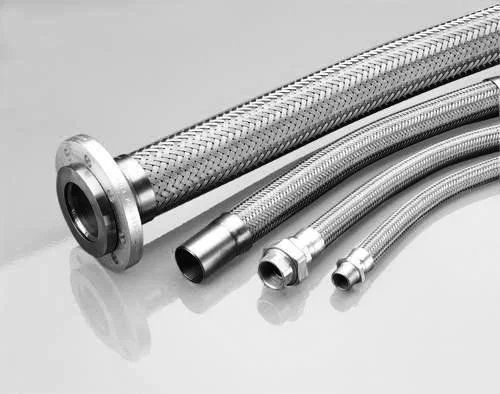
An industrial flexible hose is a pressure-carrying conduit built from three layers: an inner tube chosen for chemical and temperature compatibility, a reinforcement layer (textile braid, single wire braid, double wire braid or spiral wire) that carries the pressure load, and an outer cover that protects against abrasion, ozone and UV. Each category — hydraulic, oil and gas transfer, steam, chemical, pneumatic — uses a different combination tuned to the service, and they are not interchangeable. This article is a primer for junior buyers and fresh-graduate engineers preparing to spec a hose before going to a senior for sign-off.
Industrial flexible hose for Malaysian O&G, chemical and process service ships from Simlecco’s stock, alongside DK-Lok instrumentation fittings. The categories and constructions below align with the relevant SAE, EN, ISO and ASTM editions current at time of writing.
The Five Industrial Categories
Industrial flexible hose is grouped by service, not by material. Each category has its own controlling standard and its own construction logic.
1. Hydraulic hose
Built to carry hydraulic oil at high pressure in mobile and industrial hydraulic circuits. The controlling specifications are SAE J517:2021 (R1 through R17), EN 853:2015 (single and double wire braid) and EN 856:2018 (spiral wire).
Constructions range from textile-reinforced low-pressure return lines through to four- and six-wire spiral for heavy industrial service. Suction-side variants such as SAE 100R4 add a helix wire to resist vacuum collapse.
2. Industrial O&G transfer hose
Designed for hydrocarbon transfer at tank farms, jetties and dock terminals. The relevant standards are EN 1765:2016 for oil suction and discharge hose, EN 13765:2018 for composite multi-layer hydrocarbon transfer, and OCIMF GMPHOM 2009 for marine dock hose.
Construction is typically multi-layer nitrile or composite with embedded helix wire for vacuum capability on the suction side. Working pressures are lower than hydraulic hose but diameters and bend radii are much larger.
3. Steam hose
Built to carry saturated steam for cleaning, blowing and process service. The controlling standard is EN ISO 6134:2017, which defines tube compound, reinforcement type and pin-pricked cover.
Construction differs from hydraulic hose because the cover must be pin-pricked to vent permeated steam from between the layers. Never substitute hydraulic or general-purpose rubber hose for steam service. The reinforcement debonds under cyclic thermal load and the assembly fails dangerously.
4. Chemical hose
Selected by chemical compatibility of the inner tube. Common constructions are PTFE-lined (ASTM D3295) for the widest chemical resistance, UHMWPE-lined for solvents and aggressive acids, and chemical-resistant rubber blends specified per ASTM D2000:2022.
Always cross-check the fluid against the manufacturer chemical compatibility chart at operating temperature. Compatibility ratings shift with temperature; a compound that resists a chemical at 25 C may swell or leach at 80 C.
5. Pneumatic hose
Carries compressed air at lower pressures than hydraulic service. Common materials are polyurethane for light-duty tooling and rubber for heavier industrial service.
Pneumatic systems also need attention to upstream air quality per ISO 8573; water, oil and particulate carried into the hose shorten its life and contaminate the downstream tool. Compressor sizing is governed by ISO 1217.
Category Comparison at a Glance
| Category | Typical service | Controlling standard | Reinforcement |
|---|---|---|---|
| Hydraulic | Mobile and industrial hydraulic oil circuits | SAE J517:2021, EN 853:2015, EN 856:2018 | Textile, wire braid, wire spiral |
| O&G transfer | Tank farm and dock hydrocarbon transfer | EN 1765:2016, EN 13765:2018, OCIMF GMPHOM 2009 | Multi-layer nitrile or composite, helix wire |
| Steam | Saturated steam cleaning and process | EN ISO 6134:2017 | Wire braid, pin-pricked cover |
| Chemical | Acids, solvents, aggressive media | ASTM D3295, ASTM D2000:2022 | PTFE / UHMWPE / specialty rubber |
| Pneumatic | Compressed air tooling and process | ISO 8573, ISO 1217 (upstream air) | Polyurethane or textile-reinforced rubber |
Spec Dimensions That Matter
Before quoting a hose, capture these five dimensions. Missing any of them sends the order back to your senior with questions.
- Nominal ID. Controls flow velocity and pressure drop. Always sized to the pump or compressor OEM, not to “what fits the existing fitting”.
- Working pressure. Must exceed the maximum system pressure with the safety factor implied by the standard. SAE J517:2021 requires a 4:1 ratio between burst and working pressure.
- Burst pressure. Published value, equal to four times working pressure for SAE J517 hose.
- Temperature range. Both fluid temperature and ambient. Cover compounds degrade outside the published range even if the tube is fine.
- Minimum bend radius. Below this radius the reinforcement is overstressed and the hose loses its rated burst pressure permanently.
End Connections
An assembly is only as good as its end connections. The common families are crimped (one-time use, factory or workshop), reusable (field-serviceable for low-pressure hose), swivel JIC 37 degree per SAE J514, and ORFS (O-ring face seal) per SAE J1453 for vibration-prone hydraulic service.
Never mix crimp brands within a single assembly. The crimp diameter, die profile and ferrule design are matched as a system; mixing brands voids the working-pressure rating. See our guides on tube fitting installation and the industrial fittings range for the matching parts.
What About PVC Hose?
PVC hose has a place — water transfer, low-pressure utility, garden and washdown service. It is not an industrial process material.
For hydraulic, O&G, steam, chemical or significant pneumatic duty, specify the rubber, PTFE, UHMWPE or wire-reinforced constructions described above. Substituting PVC into industrial service is a common spec error that fails on either pressure, temperature or chemical compatibility, usually the first time the system runs hot.
Common Selection Mistakes
- Sizing the hose to the existing fitting rather than to the OEM-recommended ID.
- Using a discharge-rated hose on a suction line. Use SAE 100R4 or equivalent vacuum-rated construction instead.
- Mixing crimp brands or re-crimping a used end fitting. Both void the rated working pressure.
- Specifying chemical compatibility from a 25 C chart when the service runs at 80 C.
- Substituting hydraulic hose for steam. The cover is not pin-pricked and the reinforcement debonds.
FAQ
Should I size hose by ID or OD?
Size by nominal ID for flow and by OD only when matching a clamp or guide. ID controls velocity and pressure drop, which is what the pump or compressor cares about.
When should a flexible hose be replaced?
Replace on condition rather than calendar age. See our guide on the five warning signs that a hydraulic hose needs replacement.
Can I mix crimp brands on the same assembly?
No. Crimp diameter, die profile and ferrule design are matched as a system. Mixing brands voids the rated working pressure and is a common cause of fitting blow-off.
Is stainless steel hose a separate category?
Metallic flexible hose (corrugated stainless steel with braided overbraid) is its own category, common in cryogenic, high-temperature and instrument tubing service. ASTM A269:2022 covers the parent tubing grade.
Source Industrial Flexible Hose from Simlecco
Simlecco holds industrial flexible hose across all five categories above, plus DK-Lok instrumentation fittings for the connecting tubing runs. Send us the service (fluid, pressure, temperature), nominal ID and end-connection type, and we will quote a hose that meets the relevant SAE, EN or ISO standard. Browse our flexible hose range or read our industrial hose selection guide next.
Disclaimer: this article is general guidance for procurement and selection planning. It does not replace site-specific risk assessment, OEM service manuals or the judgement of a competent process or hydraulic engineer. Final hose selection should be reviewed against the controlling standard edition and your plant’s permit-to-work procedures.