Industrial hose fittings fail in a small number of recurring ways — leakage at the seal, mismatched thread or size, and elastomer fatigue. Identifying the failure mode at first inspection prevents the next incident on the same line. This guide covers the thread standards, the common failure modes, and the diagnostic and repair workflow appropriate for Malaysia’s humid operating envelope.
Understanding hose-fitting failure modes parallels the analysis for common hydraulic hose failures — classify the failure, then specify the right intervention.
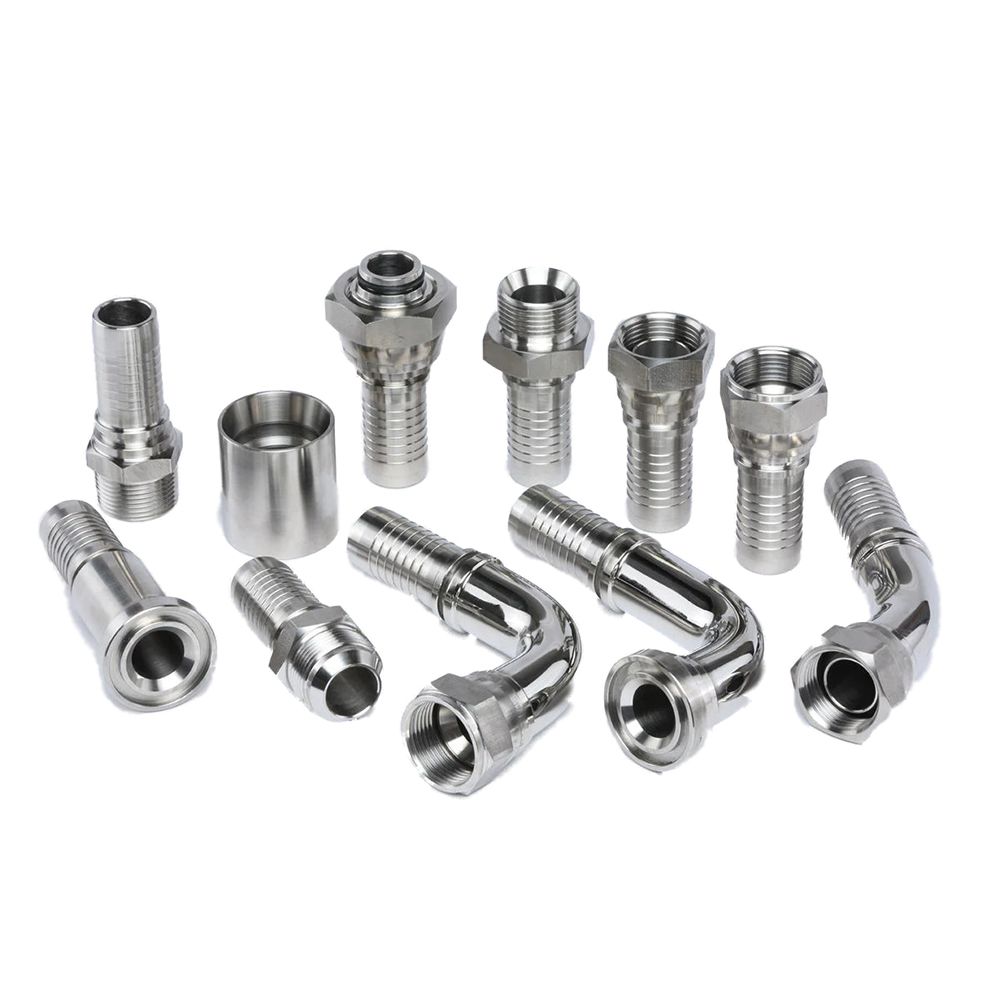
Thread Standards Used in Industrial Hose Fittings
Industrial hose fitting connections follow several thread standards. Specifying the wrong thread is the first cause of leakage on a new installation:
- NPT (ANSI/ASME B1.20.1:2013) — National Pipe Taper, 60° thread angle, tapered. Seals on thread engagement plus PTFE tape or thread sealant. Common in North American and instrumentation service.
- BSPP (ISO 228-1:2000) — British Standard Pipe Parallel, 55° thread angle, parallel. Seals on a bonded washer or O-ring at the face. Common in European and Asian equipment.
- BSPT (ISO 7-1:1994) — British Standard Pipe Taper, 55° tapered. Seals like NPT.
- JIC 37° flare (SAE J514:2018) — 37° flare seat seal, parallel thread. The most common hydraulic fitting standard.
- ORFS (SAE J1453:2018) — O-ring face seal, parallel thread with O-ring on the face. Highest-integrity hydraulic seal at elevated pressure.
- DIN 24° (ISO 8434-1:2007) — 24° cone, metric thread. Used in European and Asian hydraulic systems.
Mixing NPT with BSPT (different thread angle), or trying to mate a 37° JIC flare with a 24° DIN cone, produces a leak path that no amount of tightening will close. Confirm the thread standard at the fitting against the mating port at the equipment before specifying.
Common Issues with Industrial Hose Fittings
Industrial hose fittings exhibit a recurring set of failure modes. Identifying the mode at first observation determines whether the fix is a re-seal, a thread correction, or a full replacement:
1. Leakage at the seal: Worn elastomer seals, dry-rotted O-rings, or under-torqued fittings produce visible drips. On low-pressure pneumatic lines a slow leak is a productivity issue; on hydraulic or chemical-transfer lines it is a safety event.
2. Incorrect size or thread standard: Mismatched thread standards (NPT vs BSPT, JIC vs DIN) are a common procurement error. The fitting will appear to engage but cannot seal. Confirm thread standard and size against the equipment port before installation.
3. Elastomer fatigue and ferrule wear: Repeated pressure cycling fatigues the inner elastomer; humidity accelerates surface cracking. Crimped ferrules can develop hairline cracks at the swage line. Replace at first visible distress — ferrule failure under pressure is sudden.
Staying ahead of these failure modes through scheduled inspection allows planned replacement instead of reactive shutdown.
Read: What to Look for When Evaluating Industrial Hose Suppliers in Malaysia
Identifying and Diagnosing Issues
Early detection of a failing fitting limits the scope of intervention. Common diagnostic indicators on hose-fitting assemblies:
Visible drips at the fitting face or thread indicate seal or thread failure. Audible hissing on a pressurised line indicates a leak path. Surface cracking on the hose at the ferrule swage line indicates an imminent ferrule failure.
Diagnostic sequence:
1. Visual inspection: Examine the full hose assembly. Look for cracks, swell, kinks, or distortion. Confirm every connection is correctly torqued.
2. Listen during operation: Hissing indicates an active leak; rattling indicates loose mechanical support.
3. Leak-test the fittings: Apply soapy water to the fittings. Bubbles indicate a leak path. Soapy-water leak testing is appropriate for low-pressure pneumatic and natural gas service. Do not use soapy water on oxygen service (soap contamination is a fire-ignition risk) or on high-pressure hydraulic service (use a calibrated pressure-decay test instead).
4. Refer to manufacturer documentation: Confirm the failure mode against the manufacturer’s troubleshooting guidance for the specific fitting series.
Solutions and Repairs
Once the failure mode is identified, intervene quickly to limit secondary damage. For seal-face leaks, replace the seal or O-ring with a part of matching elastomer (NBR, EPDM, FKM, or PTFE) appropriate to the service medium and temperature.
For mismatched fittings, source the correct thread standard and size. Do not adapt across thread angles — use the matched-standard replacement. For sizing decisions see our guide to industrial hose selection.
For ferrule or hose fatigue, replace the full hose assembly. Re-crimping a fatigued hose end is not a durable repair. Our walkthrough on industrial hose clamp installation covers correct clamp setup.
Preventative Measures
Scheduled inspection is the most cost-effective control on hose-fitting reliability:
– Scheduled inspection: Visual inspection of every accessible fitting on a defined cadence catches surface cracking and seal extrusion before they become leaks.
– Correct storage: Store unused hose in cool, dry conditions away from UV. UV accelerates elastomer degradation; humidity accelerates ferrule corrosion.
– Operate within rated envelope: Confirm operating pressure and temperature against the hose and fitting ratings. Over-pressure or over-temperature operation reduces service life unpredictably.
Get Professional Help
Where the failure mode is unclear or the service is critical (high-pressure hydraulic, chemical transfer, oxygen service), consult a qualified hose-and-fitting specialist before intervening. Some failure modes — ferrule fatigue under pressure, oxygen-service contamination — are not safely diagnosed in service.
Keep Your Operations Reliable with Correctly Specified Hose Fittings
Hose-fitting reliability comes from specifying the correct thread standard, the correct elastomer, and the correct hose-to-ferrule pairing — then inspecting on a defined cadence. Reactive replacement after a failure costs more than the inspection program that would have caught it.
Explore our range of industrial hose fittings in Malaysia. Simlecco Sdn Bhd supports specification, supply, and field troubleshooting across the common thread standards.