- Why a Hose-End Failure Is a DOSH Issue, Not a Maintenance Hiccup
- Clamp Families and Where Each Belongs
- Quick Reference: Which Clamp for Which Service
- The Installation Sequence That Holds
- Common Installation Mistakes That Cause Field Failures
- Hose-Clamp Sourcing Through Simlecco
- Maintenance Schedule for Industrial Hose Clamps
- Frequently Asked Questions
- Can I use a worm-drive clamp on a steam line?
- What torque value do I use on a T-bolt clamp?
- Why does my clamp loosen after the first start-up?
- Can I reuse a T-bolt clamp on a new hose?
Industrial hose clamp installation is the difference between a leak-free reinforced-hose connection and a hose whip incident — and the choice starts upstream with industrial hose selection.
The hose, fitting and clamp combination determines the allowable service pressure; select the assembly for its pressure, temperature, fluid and maintenance requirements. The installation sequence — hose preparation, clamp positioning, torque sequence, torque value reference — decides whether the connection survives the first thermal cycle.
The wrong clamp family, the wrong position, or the wrong torque produces a hose-end failure under pressure that puts personnel in the strike path of a whipping reinforced hose. This guide walks the correct selection and the installation discipline that prevents that outcome.
Why a Hose-End Failure Is a DOSH Issue, Not a Maintenance Hiccup
A reinforced industrial hose at 150 psig stores significant pneumatic and kinetic energy. When the hose-end fitting separates from the hose under pressure, the loose end whips with enough force to break bone and crack helmets.
A worm-drive clamp specified where a T-bolt was required produces exactly this outcome under thermal cycling — the worm-drive screw flexes, the band slips, the hose end walks off the barb, the pressure releases. For the broader picture of common hydraulic hose failures, see our diagnostic guide.
A hose-end failure must be reported to DOSH if it meets the accident or dangerous-occurrence criteria in the Occupational Safety and Health (Notification of Accident, Dangerous Occurrence, Occupational Poisoning and Occupational Disease) Regulations 2004. Managerial liability depends on the applicable duties and facts, not simply on who signed the installation record.
The audit question is straightforward: was the clamp family appropriate for the service, was the installation procedure documented, and was the torque verified? Three documented checks separate a routine maintenance entry from an audit-exposed installation.
Clamp Families and Where Each Belongs
Industrial hose clamps fall into four families. The selection is service-driven — pressure, vibration, temperature cycling, access frequency, and the hose construction itself decide which family is correct.
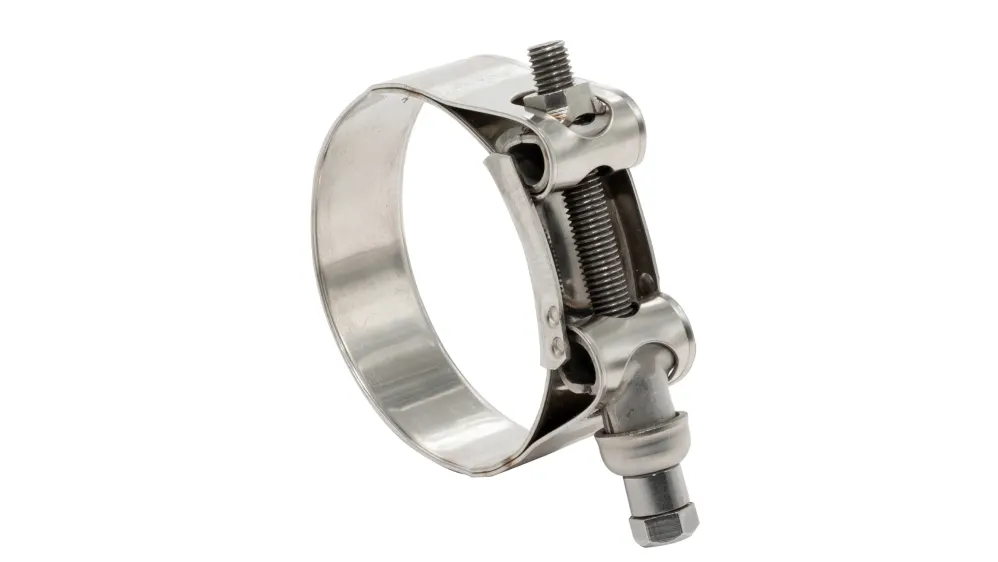
- T-bolt clamp — heavy industrial. A solid stainless band closes via a T-bolt and welded trunnion. The T-bolt provides the tightening force; vibration performance depends on the clamp design and installation. Pressure rating supports heavy reinforced hose service in process and utility lines. Use only a hose, fitting and clamp combination approved for the fluid, pressure and temperature; steam needs a steam-rated assembly.
- V-band clamp — quick-release for routine maintenance access. A V-section clamp draws mating flanges together and closes via a bolt or latch. Designed for repeated assembly and disassembly without damaging the band. Common on exhaust connections, dust-collector hose ends, and any service where the hose comes off weekly for cleaning.
- Worm-drive band clamp — general utility, with heavy-duty versions available. The familiar stamped-band hose clamp with a slotted-screw closure. Suitable designs serve cooling-water return lines and low-pressure instrument-air sub-runs. For higher-pressure or vibrating service, use only a design approved for that application.
- Stepless ear-type clamp (single-ear or two-ear) — high-spec, low-profile. A solid stainless band with one or two crimped ears that close to a precise pre-set diameter. Common on hygienic, pharmaceutical, sample-line, and chemical service where corrosion resistance and a uniform compression ring are required. Single-use — once crimped, the clamp is removed and replaced rather than re-tensioned.
Quick Reference: Which Clamp for Which Service
| Service | Clamp family | Why |
|---|---|---|
| Permanent reinforced hose on process line | T-bolt | Bolted closure; verify vibration suitability for the assembly |
| Steam supply or heavy compressed air | Service-rated coupling and clamp system | Assembly approved for the pressure, temperature and fluid |
| Dust-collector or exhaust ducting, routine cleaning | V-band | Quick removal without damaging the band |
| Cooling-water return, low-pressure utility | Worm-drive band | Adequate for low-stake service; cheap and serviceable |
| Hygienic, pharmaceutical, sample line | Stepless ear-type | Uniform compression; verify material and cleanliness requirements |
The Installation Sequence That Holds
The sequence below applies to hose-on-barb connections. V-band flange joints and ear-type clamps require their own manufacturer’s assembly procedures.
Get the sequence right and the joint holds for the design life. Skip a step and the joint fails on the first thermal cycle.
- Inspect the hose end. Cut the hose square with a sharp hose knife or a dedicated cutter, not a hacksaw. The cut face must be clean and perpendicular to the hose axis. Any angled or torn cut prevents a uniform seal against the fitting barb.
- Inspect the fitting barb. The barb must be free of nicks, scoring, or dried sealant residue from a previous installation. A scored barb produces a leak path the clamp cannot close.
- Slide the clamp onto the hose first. The clamp goes on the hose before the hose goes onto the fitting. Trying to spring an assembled clamp over an installed hose end damages the band.
- Push the hose fully onto the barb. The hose must seat to the shoulder behind the barb. A partially-seated hose can compromise retention and sealing; follow the fitting manufacturer’s insertion and clamp-position instructions.
- Position the clamp as specified for the fitting. Follow the hose and fitting manufacturer’s assembly drawing; the correct position depends on the barb and clamp design.
- Tighten to the manufacturer’s torque value. Torque the closure to the value in the clamp manufacturer’s installation datasheet. For T-bolt clamps in heavy industrial service, torque values are clamp-size-specific and typically published in the supplier’s installation booklet.
- Re-torque after the first thermal cycle. Reinforced hose creeps under initial compression. After the line is pressurised and heated to operating temperature once, the clamp is re-checked and torqued to the same target value.
Common Installation Mistakes That Cause Field Failures
- Over-torque. The fitter cranks the closure until it stops, on the theory that tighter is safer. The hose body cuts under the band, the reinforcement plies fray, and the hose fails at the clamp position within months. Use the published torque value, not feel.
- Under-torque. The opposite failure. The clamp is snugged with hand tools, not torqued. The hose slips off the barb on the first pressure spike.
- Incorrect clamp position. Positioning the band outside the area specified by the fitting manufacturer can compromise retention and sealing.
- Worm-drive on heavy service. A worm-drive band clamp specified where a T-bolt was required. The slotted band slips, the screw bends, the hose walks off the barb. This is a frequent cause of avoidable hose-end failures.
- No re-torque after first cycle. The hose creeps in service, the clamp loses preload, and the joint leaks at the second start-up. The fix is a documented re-torque step at first commissioning.
- Wrong band width for the hose. A narrow band on a thick reinforced hose concentrates the load and cuts the cover. The band width must match the hose construction per the clamp manufacturer’s selection chart.
Hose-Clamp Sourcing Through Simlecco
Single Bolt Clamps, Double Bolt Clamps (T-bolt type), ear-type clips, and matched industrial reinforced hose are held in Simlecco’s stock for Malaysian O&G, petrochemical, and process plant service.
The clamp band, the bolt grade, and the hose construction are matched as a system — the band width matches the hose OD class, the bolt grade matches the service pressure, and the stainless grade matches the corrosion environment.
Simlecco is the authorised DK-Lok distributor in Malaysia, supplying the market directly and through a network of authorised dealers. For application-specific selection of industrial hoses for oil and gas, see our sector guide.
Industrial hose and matched clamp inventory ships from Malaysian warehouse, not from a multi-week air-freight queue, when the shutdown window is tight.
Maintenance Schedule for Industrial Hose Clamps
- First commissioning — install, pressurise, heat to operating temperature, re-torque to published value.
- Routine inspection — visual check at every shift handover for visible band distortion, hose-cover damage at the band, weep at the hose-end fitting.
- Quarterly — torque verification with a calibrated tool on critical-service lines (steam, high-pressure compressed air, hazardous fluid transfer).
- At hose replacement interval — replace the clamp set when replacing the hose. Reusing a previously-installed band on a new hose carries the prior-service deformation into the new joint. See when to replace a hydraulic hose for the warning-sign checklist.
Frequently Asked Questions
Can I use a worm-drive clamp on a steam line?
Use a steam-rated hose and coupling assembly with its specified clamps or crimp system; do not substitute a general-purpose hose clamp.
What torque value do I use on a T-bolt clamp?
The clamp manufacturer publishes a torque value per clamp size in the installation datasheet. The value is size-specific. A general rule does not exist — use the supplier’s number, not a generic torque-from-feel.
Why does my clamp loosen after the first start-up?
Reinforced hose creeps under initial compression. The clamp loses preload during the first thermal cycle. The fix is a documented re-torque step after first commissioning to the same published torque value.
Can I reuse a T-bolt clamp on a new hose?
Not in industrial service. A clamp that has been torqued in service carries band deformation and bolt-stretch from the prior installation. The new joint should ship with a new clamp set matched to the new hose.
Need help sourcing industrial hose with matched Single Bolt, Double Bolt (T-bolt), or ear-type clamps?
Click the WhatsApp button on this page to speak with our technical team — or fill in the contact form and we will respond within one business day.
Disclaimer: All brand names mentioned are trademarks of their respective holders.