- How does a gate valve work?
- Parts of a gate valve
- Gate valve types
- Wedge and parallel gates, including knife gates
- Rising stem, non-rising stem and OS&Y
- Bonnet types
- Seat types
- Gate valve materials, ends and pressure classes
- Gate valve standards and what each covers
- Where gate valves are used
- Gate valve vs globe, butterfly and ball valves
- Reading a gate valve on a P&ID
- What to send a supplier
- FAQ
- What is a gate valve used for?
- What is another name for a gate valve?
- Can a gate valve be used to control flow?
- Why use a gate valve instead of a ball valve?
- Are all gate valves full bore?
- Talk to Simlecco
A gate valve moves a gate across a pipe’s flow passage to open or close it. It provides isolation, meaning it stops flow through that passage. Operate a conventional gate valve fully open or fully closed, not partly open for throttling (adjusting flow).
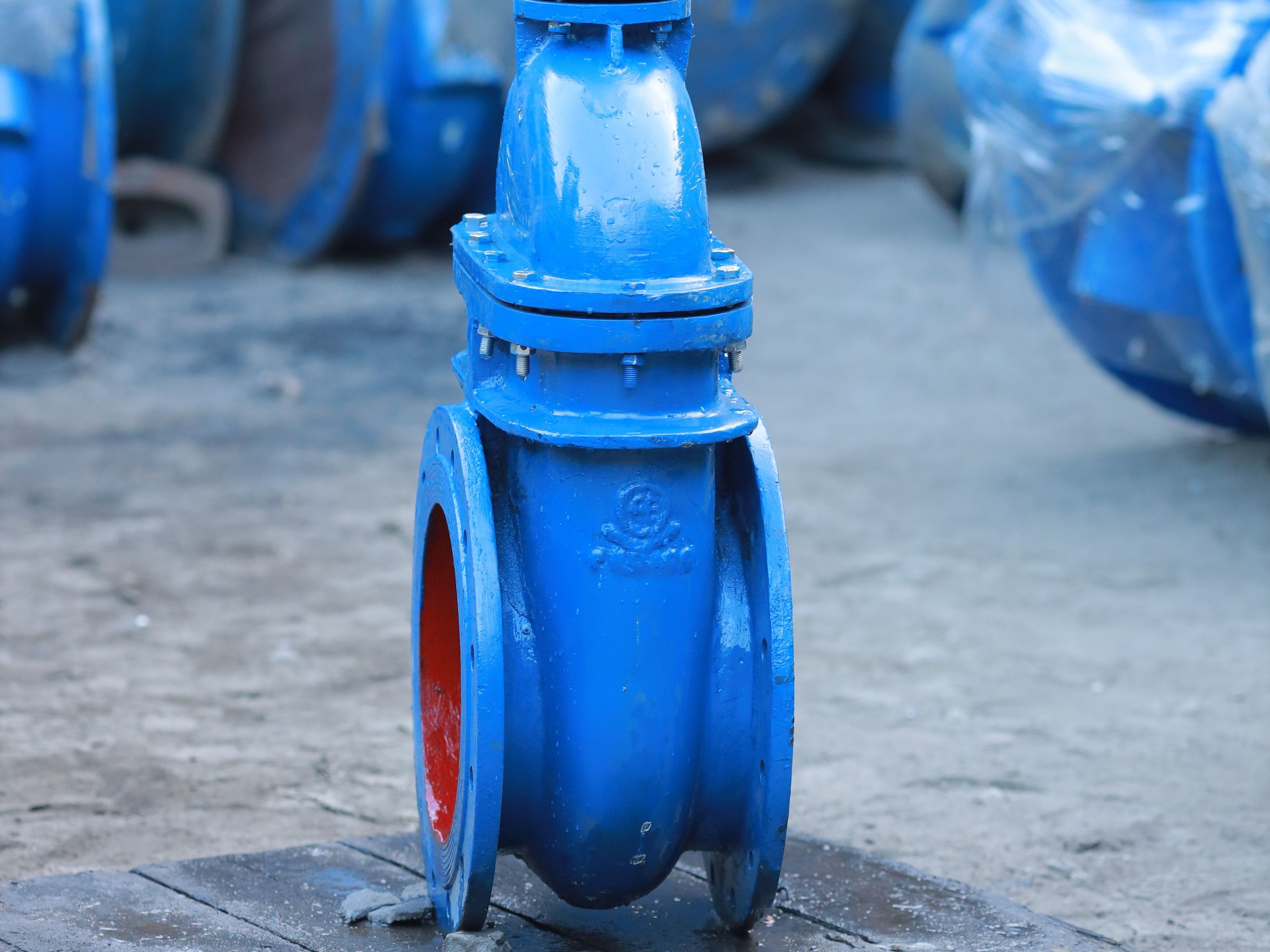
A gate valve opens or closes a passage to allow or stop fluid flow. When fully open, conventional designs offer low resistance, according to the United States Navy training manual. This guide helps you identify the parts, compare designs, read standards and drawings, and prepare an enquiry.
For the wider valve family, our guide to industrial valve types explains the alternatives used in industrial piping.
How does a gate valve work?
A gate valve opens by withdrawing its gate from across the flow passage. Closing moves the gate against its seats, the surfaces that form the seal. A conventional screw-operated valve usually takes several handwheel turns, as the Navy valve manual describes.
Its normal duty is isolation: opening or shutting off a line. Throttling means restricting the opening to adjust flow during operation. Partial opening can cause vibration and damage the seating surfaces, as the Navy manual explains.
Low pressure drop describes relatively little pressure lost through an open valve; it does not mean zero. Nor does every gate valve have a full-bore passage matching the pipe opening. The industry glossary confirms that a gate valve may not be full-opening, so check the selected design.
Parts of a gate valve
In a typical bonneted valve, the body contains pressure, while the bonnet closes the upper body. Inside, the gate closes the passage against the seats. The Department of Energy mechanical handbook describes these component roles and explains conventional valve construction.
The stem transfers movement from the operating mechanism to the gate. Packing seals around the stem, and the gland compresses that packing. Where fitted, the yoke supports the operating assembly, while a handwheel supplies the manual input.
Gate valve types
Gate valve types describe separate attributes, including the closure design, stem, bonnet and seats. A conventional bonneted valve has a gate design, stem arrangement, bonnet type and seat type. For example, a flexible-wedge valve can also have a rising stem, bolted bonnet and metal seats.
Wedge and parallel gates, including knife gates
A wedge gate seals against inclined seats, while a parallel gate uses parallel seating surfaces. A slab gate has a parallel-sided closure; the term does not automatically identify a knife gate.
Solid wedges have a solid closure, while flexible wedges have a recess that allows some flexing. Split wedges have separate parts that can align with the seats.
A knife gate has a thin closure with a cutting edge for selected duties, including wastewater and fluids containing solids. Check the selected knife gate’s pressure, sealing and fluid limits against the intended service.
Rising stem, non-rising stem and OS&Y
A rising stem moves lengthwise as the gate travels between open and closed positions. A conventional non-rising stem rotates at the same height while the gate travels along its thread.
Outside screw and yoke (OS&Y) describes the screw and supporting arrangement. The Public Works Department (JKR) notes also describe rising-stem designs with an inside screw.
Bonnet types
Bolted bonnets fasten to the body, while union bonnets use a union connection that permits disassembly. A welded bonnet has a permanent joint that is not routinely dismantled during servicing.
A pressure-seal bonnet uses internal pressure to increase sealing force, as the government engineering manual describes for high-pressure, high-temperature duties.
Seat types
Metal-seated valves use metal sealing surfaces, while resilient-seated valves use a deformable sealing element. Match the sealing material to the fluid and temperature, even when the body material suits the service.
Gate valve materials, ends and pressure classes
Gate valve materials must suit the fluid, pressure and temperature together. An ASME pressure class is a designation used with pressure and temperature rating tables, not an allowable pressure on its own. ASME B16.34 addresses these ratings, along with other requirements for new valve construction within its scope.
Grey cast iron and bronze appear in building-services specifications as ASTM A126 and ASTM B62, respectively. A university valve specification documents both materials but does not establish a universal cast-iron grade.
Ductile iron also serves water systems; one utility specification names ASTM A536 Grade 65-45-12. That grade is an example from that specification, not a requirement for every water valve.
For high-temperature service, ASTM A216 covers carbon-steel castings, including grades WCB and WCC. “Forged steel” describes how the steel is made; ASTM A105 covers carbon-steel forgings.
Stainless examples include ASTM A351 castings in grades CF8 and CF8M. The engineering material schedules also list ASTM A182 forgings in grades F304 and F316. The stainless grade still needs to be checked against the fluid, pressure, and temperature of the intended service.
Ends may be flanged, threaded, socket-weld or butt-weld, as reflected in the steel gate-valve scope. A waterworks socket end should not be assumed to mean a steel socket-weld connection. Match the connection details and pressure rating to the pipe specification before ordering.
Gate valve standards and what each covers
Gate valve standards cover different jobs, including construction, dimensions and pressure testing. No single document applies to every gate valve. The API refining catalogue distinguishes the construction requirements of different valve families from inspection and testing.
| Standard | What it covers | Typical use |
|---|---|---|
| API 600 | Heavy-duty, bolted-bonnet steel gates with flanged or butt-weld ends | Refinery and related isolation |
| API 602, 11th-edition scope | Compact gate, globe and check valves | Petroleum and natural-gas systems |
| API 603, 10th edition | Corrosion-resistant, bolted-bonnet gates with flanged or butt-weld ends | Specified corrosion-resistant construction |
| API 6D | Several valve families, including design, manufacture, testing and documentation | Petroleum and natural-gas applications |
| ASME B16.34 | New valve construction, ratings, materials, examination, testing and marking | Checking construction and ratings |
| ASME B16.10 | Face-to-face and other specified valve dimensions | Checking installation dimensions |
| ASME B16.5 | Pipe flanges and flanged fittings, including ratings and dimensions | Matching flange requirements |
| MSS SP-70 | Grey-iron gate valves with flanged or threaded ends | General-purpose iron valves |
| MSS SP-80 | Bronze gate, globe, angle and check valves | General-purpose bronze valves |
| API 598 | Inspection, examination and pressure testing across valve types and seats | Specifying tests and acceptance requirements |
| ISO 5208:2015 | Metallic valve integrity, closure tightness and closure-mechanism tests | Testing with the applicable product standard |
| BS EN 1171:2015 | Cast-iron gates with flanged, socket or spigot ends | Industrial and general-purpose applications |
| BS EN 1984:2010 | Steel gates with flanged, threaded or welding ends | Industrial and general-purpose applications |
| BS 5163-1:2004 | Selection and operation of predominantly key-operated cast-iron gates | Waterworks valve selection |
| BS 5163-2:2004 | Stem caps for isolating valves and associated apparatus | Water-control operating interfaces |
| ISO 10434:2020 | Heavy-duty, bolted-bonnet steel gates with OS&Y rising stems, metallic seats and flanged or butt-weld ends | Refinery and related applications |
API 600 defines sizes and pressure classes; its historical 13th-edition scope does not establish current size and class combinations.
The purchaser names the construction standard, its edition and the test standard for each order.
Where gate valves are used
Gate valves provide isolation in water, wastewater, process and steam systems. The construction must match the service, including any solids carried by the fluid. Conventional wedge gates and knife gates are not automatically interchangeable in wastewater duty.
Oil-and-gas applications include refinery and production-system isolation, with construction requirements selected for the duty. In steam systems, flexible wedges can accommodate seat-alignment changes caused by heat. The Department of Energy handbook describes this benefit but does not require flexible wedges.
The insurer guidance describes an OS&Y gate valve in a fire pump’s inlet pipe. That example does not establish a Malaysian statutory requirement for every fire-protection system.
Malaysia’s MS 1210-2:1991, confirmed in 2026, concerns landing valves for dry risers. Its copper-alloy gate-valve provisions belong to that equipment scope, not general industrial gate valves.
Gate valve vs globe, butterfly and ball valves
Conventional gate valves mainly provide isolation, while globe valves suit flow regulation. A butterfly valve rotates a disc that remains within the passage when open. The Navy valve manual explains how closure movement and the open flow passage differ between these designs.
| Feature | Gate | Globe | Butterfly | Ball |
|---|---|---|---|---|
| Motion | The gate moves across the passage | The closure moves relative to the seat | The disc rotates | A ball with a hole through it rotates |
| Primary duty | Isolation | Regulation or isolation | Isolation; regulation where suitable | Isolation; check design for regulation |
| Sustained throttling | Unsuitable for conventional designs | Suited when selected for duty | Depends on design and conditions | Check the selected design’s suitability |
| Operating travel | Usually multiple handwheel turns | Depends on operating mechanism | Normally quarter-turn | Normally quarter-turn |
| Open-flow resistance | Low in conventional open designs | Usually higher than an unobstructed gate | Disc remains in passage | Check bore and model data |
For quick operation, the ball valve’s quarter-turn movement differs from the gate’s usual multiple turns. Our ball valve vs gate valve guide develops that comparison; you can also read how a plug valve works.
“Sluice valve” often means a gate valve in water piping, as JKR’s engineering notes demonstrate. Check the context when the term describes an open-channel sluice gate instead of a pipeline valve.
Reading a gate valve on a P&ID
A piping and instrumentation diagram (P&ID) may use the same outline for gate and globe valves. The Department of Energy drawing handbook explicitly notes this overlap. Use the drawing’s legend and identifying information to determine which valve is intended.
ISO 10628-2:2012 concerns symbols for chemical and petrochemical diagrams. ISA-5.1 concerns instrumentation and control symbols and identification. These public summaries do not verify a specific gate-valve symbol.
What to send a supplier
A gate-valve enquiry needs service conditions as well as a size and pressure class. Construction, testing and documentation requirements should be stated separately. The engineering procurement framework uses separate documents for construction requirements, testing and supplier information.
- State the fluid, its composition, any solids and the intended isolation duty.
- Give the operating and design pressures, temperatures and relevant pressure difference across the valve.
- Specify the nominal pipe size and required bore (the internal flow opening).
- Identify the gate design, stem arrangement, bonnet, seats and required operating mechanism.
- List the body, bonnet and trim materials; trim means the specified internal working parts.
- Describe both end connections and the matching pipe or flange details.
- Name the construction and test standards, editions, acceptance criteria and project requirements.
- Request the required drawings, material certificates, inspection records and pressure-test results.
Note for Procurement: Keep the service conditions and construction details together in your enquiry. Ask which drawings, material certificates, inspection records and pressure-test results are available in the form your contract requires. Before specifying the document package, read what a distributor can and cannot certify.
A sticking or leaking valve needs diagnosis. Read why a gate valve gets stuck for troubleshooting guidance.
FAQ
Gate-valve selection depends on both the construction and the intended service conditions. These answers address common identification and selection questions without assuming every design behaves the same way.
What is a gate valve used for?
Gate valves isolate pipelines by opening or closing their flow passages. Applications include water and wastewater, process and steam systems, using constructions suited to each duty. Match the construction to the fluid, pressure, temperature and sealing requirements of the intended line.
What is another name for a gate valve?
“Sluice valve” is often another name for a gate valve in water-piping work. The JKR engineering notes from Malaysia’s Public Works Department use both names for this valve family. Check the surrounding equipment to distinguish a pipeline valve from a sluice gate in an open channel.
Can a gate valve be used to control flow?
Do not select a conventional gate valve for sustained throttling, meaning operation partly open to adjust flow. Partial opening can cause vibration and seating damage during service. Choose a valve designed for regulation, such as a suitably selected globe valve, when you need adjustable flow.
Why use a gate valve instead of a ball valve?
For shutoff, a gate valve can offer low resistance when fully open. A ball valve normally offers quarter-turn operation, while a conventional screw-operated gate usually takes multiple turns. Compare the selected designs against the service requirements; neither family is universally better for sealing, pressure rating or service life.
Are all gate valves full bore?
Not every gate valve provides a full-opening passage, so check whether its bore matches the pipe opening. Check the required internal opening against the valve drawing and specification before ordering. The name “gate valve” alone does not confirm that the passage meets your clearance requirements.
Talk to Simlecco
Simlecco is the authorised DK-Lok distributor in Malaysia and supplies industrial valves, hoses and fittings. Send your service conditions and checklist details with an enquiry through Simlecco’s gate valve page. Ask Simlecco to confirm the proposed valve’s specification and documents against your requirements.
All brand names mentioned are trademarks of their respective holders.
Sources: United States Navy training manuals; Department of Energy handbooks; industry glossary; API, ASME, ASTM, ISO, MSS and BSI publications; JKR engineering notes; government engineering manual; university and utility specifications; engineering procurement documents; insurer fire-pump guidance; Department of Standards Malaysia preview.